What is Evidence-Based Management™ (EBM)?
Improving Value Delivery Under Conditions of Uncertainty
What is Evidence-Based Management?
Evidence-Based Management (EBM) is a powerful framework designed to help individuals, teams, and organizations make better-informed decisions through deliberate experimentation and continuous feedback. By applying EBM, organizations can more effectively measure, manage, and maximize the value delivered through their products and services.
Developed and maintained by Ken Schwaber and Scrum.org, EBM emphasizes outcomes over outputs. It guides organizations to focus on:
-
Improving results and customer satisfaction
-
Measuring actual value delivered
-
Reducing risk through transparency and learning
-
Optimizing investments based on evidence and impact
EBM empowers organizations to adapt quickly, invest wisely, and continuously improve in complex, changing environments.
Why Evidence-Based Management?
In an increasingly uncertain world, the path to achieving meaningful goals is rarely straightforward. Markets shift, customer needs evolve, and unexpected challenges arise. Evidence-Based Management (EBM) offers a practical approach to making steady progress—even when the exact path is unknown or unknowable.
Rather than relying on rigid plans or assumptions, EBM helps teams and organizations adapt through incremental learning, feedback, and data-driven decision-making. It empowers them to continuously assess what’s working, what’s not, and how to move forward with confidence.
Organizations exist to accomplish something unique—something they believe they are best positioned to achieve. This purpose is often expressed at various levels to create clarity, direction, and alignment. Whether it’s a long-term vision, a strategic goal, or a product mission, EBM connects purpose with measurable progress, ensuring that every step taken delivers real value.
Every successful organization starts with a clear Vision—an inspiring expression of the change it seeks to make in the world. This is supported by a Mission, which defines why the organization is uniquely positioned to realize that vision. To make progress, organizations define goals—at various levels and timescales—that serve as stepping stones toward achieving their broader purpose.
However, many organizations struggle to translate their Vision and Mission into concrete, actionable goals. Without meaningful goals, even the most compelling mission can remain abstract. And without a clear purpose, goals can feel disconnected—especially in environments filled with uncertainty and change.
This is where Evidence-Based Management (EBM) becomes essential.
EBM enables organizations to:
-
Set effective goals at long-term, intermediate, and short-term levels
-
Align those goals with their overarching Mission and Vision
-
Use empirical data from real-world experiments to measure progress
-
Continuously adapt based on outcomes, not assumptions
By integrating EBM into their strategy, organizations gain a structured way to track progress, validate direction, and remain agile—even when the future is unclear. This turns lofty aspirations into measurable, achievable progress.
The Evidence-Based Management Guide
Evidence-Based Management (EBM) was created by Ken Schwaber, co-creator of Scrum, as a way to help organizations make better decisions and deliver more value through empirical, outcome-based practices.
First released in 2015 by Scrum.org, EBM was introduced alongside a comprehensive body of knowledge: the Evidence-Based Management Guide. Since its initial release, the guide has been thoughtfully updated to reflect evolving industry insights and best practices, with new versions published in 2018, 2020, and most recently in 2024.
These continuous updates ensure that EBM remains a relevant and powerful framework for navigating today’s fast-changing, complex business environments.
Applying Evidence-Based Management in Practice
1. Align Strategic Goals with the Organization’s Mission and Vision
To create meaningful impact, strategic goals must be aligned with the organization’s overarching mission and vision. Expressing these goals in terms of customer outcomes and satisfaction gaps helps ensure the focus remains on delivering value—not just completing internal tasks.
Moreover, clearly defining how success will be measured for each goal provides valuable feedback to guide decisions and adjustments along the way.
2. Form Intermediate Goals to Guide Progress
Strategic goals are often ambitious and span multiple years. To maintain momentum and clarity, organizations should define Intermediate Goals that serve as near-term milestones. These often focus on addressing customer satisfaction gaps or improving internal capabilities needed to deliver value effectively.
3. Take Short, Measurable Steps with Immediate Tactical Goals
Short-term or Immediate Tactical Goals provide actionable targets that can be pursued in weeks or months. Teams identify hypotheses for improvement, run small experiments, and measure outcomes. This feedback loop allows organizations to refine their approach, learn continuously, and decide whether to pursue, pivot, or evolve their long-term goals.
4. Use the Key Value Areas (KVAs) as a Compass
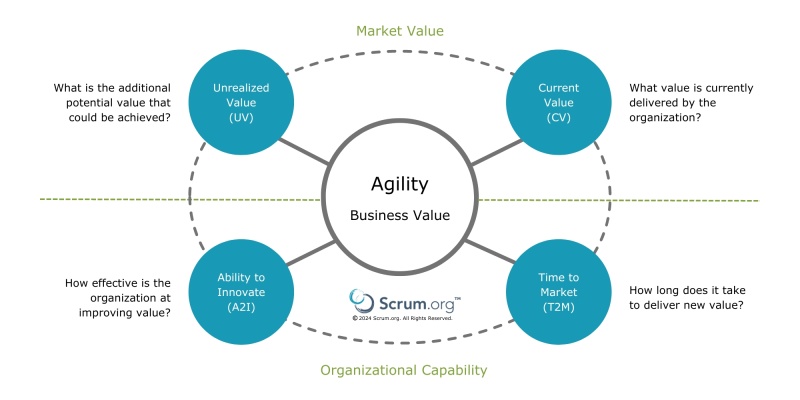
The Key Value Areas—Current Value, Unrealized Value, Time to Market, and Ability to Innovate—offer measurable focus points that help organizations assess how well they are delivering market value. These areas ensure a balanced and outcome-driven approach to improvement, guiding goal-setting and prioritization.
The Evidence-Based Management Guide
In Evidence-Based Management (EBM), the Key Value Areas (KVAs) serve as powerful lenses that help teams and organizations assess different dimensions of performance and opportunity. By examining these areas, organizations can uncover improvement paths, measure progress, and make informed, evidence-based decisions.
To understand whether efforts are resulting in meaningful change, teams use Key Value Indicators (KVIs)—specific, measurable metrics selected within each KVA. These indicators help determine if experiments and changes are driving real improvement.
Each Key Value Area is outlined below, along with its purpose:
🔹 Current Value (CV)
Quantifies the value being delivered today to customers, users, and stakeholders.
Key Question: Are we delivering meaningful value right now?
🔹 Unrealized Value (UV)
Measures the future potential value that could be captured by better serving current or untapped users and markets.
Key Question: What opportunities are we missing?
🔹 Ability to Innovate (A2I)
Evaluates the organization’s capacity to deliver new ideas and capabilities effectively.
Key Question: How well can we adapt, evolve, and innovate?
🔹 Time to Market (T2M)
Assesses how quickly the organization can deliver value and gather feedback from the market.
Key Question: How fast can we respond and learn?
Exploring and improving across these four Key Value Areas shines a light on your organization’s capabilities, delivery practices, and strategic potential. Over time, this structured approach supports organizational learning, drives continuous improvement, and helps build a sustainable competitive advantage.