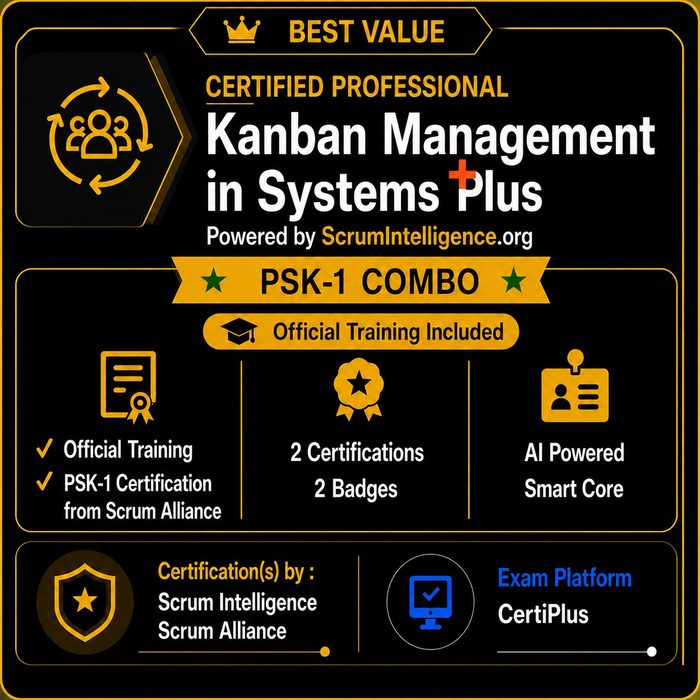
Kanban Management in Systems Plus Certification - Professional Level | Scrum Intelligence

Kanban Management in Systems Plus
★ Core Kanban Skills ★
Flow Efficiency Optimize delivery
WIP Limits Control capacity
Cycle Time Measure speed
Pull System Demand-driven
Why Kanban Management
Visualize workflow, limit work-in-progress
In-demand across Scrum, SAFe, hybrid teams
Powered byScrumIntelligence.org
Foundation

What is Scrum?

Scrum is a lightweight framework that helps individuals, teams, and organisations generate value through adaptive solutions for complex problems. Created by Ken Schwaber and Jeff Sutherland, Scrum is the world's most widely adopted agile framework — used by over 58% of software organisations globally and across banking, healthcare, e-commerce, and government sectors.

Scrum breaks complex work into short focused cycles called Sprints — typically 1 to 4 weeks — and continuously inspects and adapts based on real feedback. This allows teams to deliver value early, change direction quickly, and improve continuously.

Official Definition · Scrum Guide 2020
"Scrum is a lightweight framework that helps people, teams and organisations generate value through adaptive solutions for complex problems."
Ken Schwaber and Jeff Sutherland

The Three Pillars of Scrum

🔍
Transparency
All significant aspects must be visible to those responsible for the outcome.
🔎
Inspection
Practitioners regularly inspect artifacts and progress to detect undesirable variances.
Adaptation
When inspection reveals problems, the process must be adjusted as soon as possible.

The Five Scrum Values

C
Commitment
The Scrum Team commits to achieving goals and supporting each other — accountability for outcomes.
F
Focus
Primary focus on Sprint work and goals — eliminating multitasking and improving quality.
O
Openness
The team and stakeholders are open about all work and challenges they face.
R
Respect
Team members respect each other as capable, independent individuals — the foundation of trust.
C
Courage
The courage to do the right thing, surface impediments honestly, and have difficult conversations.

The Three Scrum Accountabilities

🎯
Scrum Master
Accountable for establishing Scrum. Coaches the team, facilitates events, removes impediments.
💡
Product Owner
Accountable for maximising product value. Manages the Product Backlog and Product Goal.
⚙️
Developers
Self-managing professionals committed to creating a usable Increment each Sprint.

The Five Scrum Events

🔄 The Sprint
The heart of Scrum — fixed-length event of 1 month or less. All other events happen within the Sprint.
📋 Sprint Planning
Initiates each Sprint. Team defines Sprint Goal and selects backlog items. Max 8 hours.
☀️ Daily Scrum
15-minute daily event for Developers to inspect progress and adapt the Sprint Backlog.
🔍 Sprint Review
Inspect Sprint outcome with stakeholders. Collaborative working session. Max 4 hours.
💬 Sprint Retrospective
Team inspects how the Sprint went and creates improvement plan. Max 3 hours.

The Three Scrum Artifacts

📋
Product Backlog
Commitment: Product Goal
Ordered list of everything needed in the product. Single source of work.
Sprint Backlog
Commitment: Sprint Goal
Sprint Goal + selected items + delivery plan. Created by Developers.
Increment
Commitment: Definition of Done
Concrete stepping stone toward Product Goal. Must be usable.

Why Scrum Matters — Industry Data

58%
of software organisations use Scrum
37%
faster time-to-market with agile
25%
salary premium for certified professionals
70%
of Indian IT companies use agile

Scrum vs Traditional Project Management

Aspect Scrum Traditional
PlanningAdaptive — evolves with learningPredictive — planned upfront
DeliveryIncremental — value every SprintSequential — value at end
ChangeWelcomed — competitive advantageResisted — formal process
CustomerContinuous — every SprintMinimal — start and end
TeamSelf-managing, cross-functionalHierarchical, specialised
Overview

About Kanban Management in Systems Plus

The Certified Professional Kanban Management in Systems Plus is designed for professionals who want to master Kanban as a method for visualizing work, managing flow, and driving continuous improvement — whether or not their team uses Scrum. Kanban is one of the most widely adopted Lean-Agile methods because of its flexibility: it can be layered onto almost any existing workflow without requiring a full process overhaul.

Where Scrum organizes work into fixed-length Sprints, Kanban focuses on continuous flow, visualizing work-in-progress, and limiting how much work is active at any one time (WIP limits) to reduce bottlenecks and improve delivery predictability. This makes it especially valuable for support teams, operations teams, and any group whose work arrives unpredictably rather than in neat batches.

This certification, built on Scrum Intelligence's AI-powered learning platform, teaches you how to design an effective Kanban board, set and tune WIP limits, measure flow using cycle time and throughput, and lead a team through Kanban's evolutionary approach to change. You can complete it as a standalone Scrum Intelligence CertiPlus credential, or combine it with an official Kanban exam from Scrum Alliance (Kanban credential), giving you a credential recognized across Lean-Agile hiring.
What You Will Learn

Learning Objectives

1
Explain the core principles and practices of the Kanban Method
2
Design an effective Kanban board that reflects real workflow
3
Set, tune, and enforce Work-In-Progress (WIP) limits to improve flow
4
Measure and interpret flow metrics: cycle time, lead time, and throughput
5
Identify and resolve bottlenecks in a team's workflow
6
Facilitate Kanban's core cadences (replenishment, delivery planning, standups)
7
Apply Kanban's evolutionary change approach to introduce improvements without disruption
8
Compare and combine Kanban with Scrum where appropriate (Scrumban)
Course Content

Detailed Syllabus

Module 1: Introduction to Kanban

The origins of Kanban in Lean manufacturing, its adaptation to knowledge work, and the core principles that distinguish it from Scrum.

Module 2: Visualizing Work

Designing a Kanban board that accurately represents your team's real workflow, including swimlanes, columns, and card design.

Module 3: Managing Flow with WIP Limits

Setting effective Work-In-Progress limits, why limiting work improves throughput, and how to handle resistance to WIP limits.

Module 4: Flow Metrics

Cycle time, lead time, throughput, and cumulative flow diagrams — how to read them and use them to guide improvement.

Module 5: Kanban Cadences

Replenishment meetings, delivery planning, and daily standups adapted for flow-based work rather than Sprint-based work.

Module 6: Evolutionary Change

Kanban's philosophy of starting with what you do now and improving incrementally, rather than a disruptive process overhaul.

Module 7: Exam Preparation

Practice scenarios and review sessions to prepare for your chosen certification exam.

Who Should Attend

Is This Right For You?

This certification is best suited for:

Team leads and managers on support, operations, or maintenance teams with unpredictable work arrival
Scrum Masters who want to add Kanban and flow-based thinking to their toolkit
Project coordinators working in environments where fixed Sprints do not fit well
Professionals in IT operations, DevOps, or service delivery teams
Anyone wanting a practical, low-disruption way to introduce Agile practices to an existing team

Prerequisites

No prior Scrum certification is required. The programme is designed for motivated professionals from any background. Recommended: 6-12 months professional work experience, basic familiarity with project delivery concepts, and genuine interest in agile leadership. To combine CertiPlus with CSM (Scrum Alliance), participants separately enroll with an authorised Scrum Alliance trainer for the 2-day CSM course. For PSM-I (Scrum.org), no mandatory training is required — candidates take the assessment directly. Scrum Intelligence provides the Scrum Guide 2020, pre-course reading materials, and a self-assessment tool to all enrolled participants before the programme begins.
Certification Assessment

Exam & Certification Details

📝
60
Questions
⏱️
90
Minutes
🎯
70%
Pass Score
🔄
2
Attempts
Certification Details
Exam FormatOnline proctored — take from any location with webcam
Question TypeScenario-based multiple choice
Passing Score70% — 42 out of 60 questions correct
Duration90 minutes
Attempts2 included in course fee
CertificateDigital certificate within 24 hours of passing
Digital BadgeLinkedIn-shareable badge within 48 hours
ValidityLifetime — no expiry, no renewal fee
LanguageEnglish
Practice Exams2 full-length practice exams included
The Scrum Intelligence CertiPlus assessment is a scenario-based, open-book exam testing your ability to design Kanban boards, set WIP limits, and interpret flow metrics in realistic team situations.

If you choose the combo option, you will also sit the official Kanban exam from Scrum Alliance, which covers Kanban principles and practices as defined by the Kanban community. Exact question counts, timing, and passing score are set by Scrum Alliance — check their official site for the current exam specification before booking your attempt.
Career Outcomes

Your Career After Certification

Entry Level (0-2 yrs)
₹6–10 LPA
With CertiPlus + CSM
Mid Level (3-5 yrs)
₹10–18 LPA
Senior Scrum Master
Senior (6+ yrs)
₹18–28 LPA
Agile Coach / Lead

Data from Naukri, LinkedIn Salary Insights, Glassdoor India 2024-2025. Individual outcomes vary.

Kanban skills are highly transferable across industries because flow-based thinking applies to almost any kind of work. This certification can help you:

Introduce and lead Kanban adoption on teams where Scrum does not fit well
Qualify for roles in IT operations, service delivery, and support team leadership
Strengthen your profile as a well-rounded Agile practitioner who understands both Scrum and Kanban
Improve delivery predictability and reduce bottlenecks on any team you lead

Kanban is often combined with other Agile skills (like Scrum Mastery) rather than used as a standalone job title — it is best viewed as a powerful addition to your existing Agile skill set.
FAQs

Frequently Asked Questions

Do I need to know Scrum before learning Kanban?
No. Kanban is a separate method and can be learned and applied independently of Scrum, though many practitioners find it useful to understand both.
Can Kanban and Scrum be used together?
Yes. Many teams combine the two in an approach often called "Scrumban" — using Scrum's roles and events alongside Kanban's flow-based visualization and WIP limits.
Is Kanban only for software teams?
No. Kanban originated in manufacturing and is now used by marketing, HR, operations, support, and many other types of teams to visualize and manage their work.
What is the standalone versus combo option here?
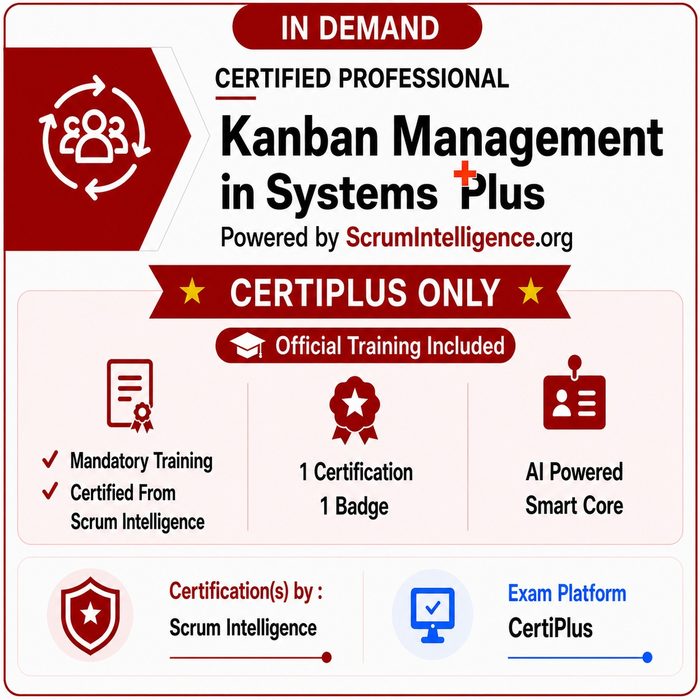
The standalone option includes the Scrum Intelligence CertiPlus training and exam only. The combo option adds an official Kanban exam voucher from Scrum Alliance, giving you two credentials.
Is the Kanban Management in Systems Plus training live or self-paced?
Entirely self-paced. Your course material is available online as soon as you enrol and you work through it whenever it suits you. There are no fixed class timings, no need to take leave from work, and the assessment is taken online at a time you choose.
How long is the Kanban Management in Systems Plus credential valid for?
Two years from the date of issue. We send renewal reminders as the expiry date approaches, and renewal keeps the same credential ID so anything you have already shared — your CV, LinkedIn profile or email signature — stays accurate. Expired credentials show as expired on our public verification page until renewed.
How can an employer verify this certification?
Every certificate carries a unique credential ID and a QR code. An employer can scan the code or enter the ID on our public verification page and immediately see the holder's name, the certification, the issue date and the current status. Because verification is live rather than a static PDF check, suspended, revoked or expired credentials show accordingly.
Do I get a digital badge with the Kanban Management in Systems Plus certification?
Yes. Alongside your certificate you receive a digital badge you can download from your dashboard and add to your LinkedIn profile, CV or email signature. A one-click LinkedIn share is included, and it carries your verification link so anyone viewing the post can confirm the credential.
What happens if I do not pass the assessment first time?
Your first two attempts are included in the enrolment fee, so a single difficult sitting does not mean paying again. You keep full access to your course material and can retake the assessment once you have reviewed the areas you found hard.
Is the exam fee included in the 325 US dollar price?
Yes. The US $325 covers the complete course material, the CertiPlus assessment, your first two attempts, your digital certificate and your digital badge. Nothing is added at checkout. If you choose a combination option that includes an official partner credential, that partner's exam fee is shown separately and clearly before you pay.
How many hours of study does Kanban Management in Systems Plus require?
Around 16 hours of material in total. Because the course is self-paced you can spread that across a few weeks of evenings, or work through it in a more concentrated block if you have the time available. Most people complete it within two to three weeks.
Quick Facts
LevelProfessional
TrackKanban
ExamIncluded
Attempts2 Included
BadgeDigital ✓
ValidityLifetime
LanguageEnglish
Combine With

Earn alongside an officially recognised certification for maximum career impact.

🎓
PSK1 (by Scrum Alliance)
Learn more ↗
Need Guidance?

Not sure which package is right for you? Talk to our experts.

Get Free Advice 💬 WhatsApp
We will contact you within 4 business hours

Ready to Get Certified?

Join certified professionals globally. Enroll today and start your certification journey with Scrum Intelligence.

🎓
Aria - Scrum Intelligence
🎓
Hi! I am Aria. Ask me about certifications, enrollment or salaries!
Which cert suits me?CSM vs PSM?How to enroll?