What is Scrum?
Scrum is a lightweight framework that helps individuals, teams, and organisations generate value through adaptive solutions for complex problems. Created by Ken Schwaber and Jeff Sutherland, Scrum is the world's most widely adopted agile framework — used by over 58% of software organisations globally and across banking, healthcare, e-commerce, and government sectors.
Scrum breaks complex work into short focused cycles called Sprints — typically 1 to 4 weeks — and continuously inspects and adapts based on real feedback. This allows teams to deliver value early, change direction quickly, and improve continuously.
Official Definition · Scrum Guide 2020
"Scrum is a lightweight framework that helps people, teams and organisations generate value through adaptive solutions for complex problems."
Ken Schwaber and Jeff Sutherland
The Three Pillars of Scrum
🔍
Transparency
All significant aspects must be visible to those responsible for the outcome.
🔎
Inspection
Practitioners regularly inspect artifacts and progress to detect undesirable variances.
⚡
Adaptation
When inspection reveals problems, the process must be adjusted as soon as possible.
The Five Scrum Values
C
Commitment
The Scrum Team commits to achieving goals and supporting each other — accountability for outcomes.
F
Focus
Primary focus on Sprint work and goals — eliminating multitasking and improving quality.
O
Openness
The team and stakeholders are open about all work and challenges they face.
R
Respect
Team members respect each other as capable, independent individuals — the foundation of trust.
C
Courage
The courage to do the right thing, surface impediments honestly, and have difficult conversations.
The Three Scrum Accountabilities
🎯
Scrum Master
Accountable for establishing Scrum. Coaches the team, facilitates events, removes impediments.
💡
Product Owner
Accountable for maximising product value. Manages the Product Backlog and Product Goal.
⚙️
Developers
Self-managing professionals committed to creating a usable Increment each Sprint.
The Five Scrum Events
🔄 The Sprint
The heart of Scrum — fixed-length event of 1 month or less. All other events happen within the Sprint.
📋 Sprint Planning
Initiates each Sprint. Team defines Sprint Goal and selects backlog items. Max 8 hours.
☀️ Daily Scrum
15-minute daily event for Developers to inspect progress and adapt the Sprint Backlog.
🔍 Sprint Review
Inspect Sprint outcome with stakeholders. Collaborative working session. Max 4 hours.
💬 Sprint Retrospective
Team inspects how the Sprint went and creates improvement plan. Max 3 hours.
The Three Scrum Artifacts
📋
Product Backlog
Commitment: Product Goal
Ordered list of everything needed in the product. Single source of work.
⚡
Sprint Backlog
Commitment: Sprint Goal
Sprint Goal + selected items + delivery plan. Created by Developers.
✅
Increment
Commitment: Definition of Done
Concrete stepping stone toward Product Goal. Must be usable.
Why Scrum Matters — Industry Data
58%
of software organisations use Scrum
37%
faster time-to-market with agile
25%
salary premium for certified professionals
70%
of Indian IT companies use agile
Scrum vs Traditional Project Management
| Aspect |
Scrum |
Traditional |
| Planning | Adaptive — evolves with learning | Predictive — planned upfront |
| Delivery | Incremental — value every Sprint | Sequential — value at end |
| Change | Welcomed — competitive advantage | Resisted — formal process |
| Customer | Continuous — every Sprint | Minimal — start and end |
| Team | Self-managing, cross-functional | Hierarchical, specialised |
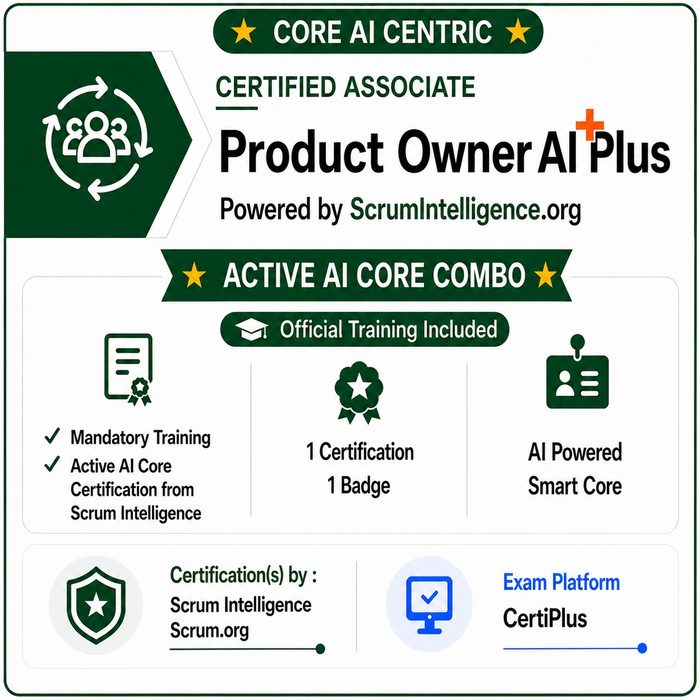
About Product Owner AI Plus
Product ownership has always been a judgement role: deciding what matters most, saying no to good ideas, and defending priority under pressure. AI does not remove that judgement, but it changes how much information you can bring to it.
Product Owner AI Plus is built around that shift. Instead of spending hours reading through support tickets and survey responses, you learn to have AI cluster them into themes and surface what is actually being asked for. Instead of writing every user story from scratch, you learn prompt techniques that produce solid first drafts you then refine. Instead of guessing at market direction, you learn to use AI to summarise competitor moves and industry signals into something you can act on.
The course is deliberately practical. Every module maps to something a Product Owner does in a normal week, and each one covers where AI genuinely helps and where trusting it would be a mistake. You will also cover the governance side — what customer data can safely pass through third-party tools, and how to answer security questions from your organisation.
For employers, an AI Product Owner certification signals that you can work at pace without losing rigour. As product teams adopt AI across discovery and delivery, that combination becomes the baseline expectation rather than a differentiator.
Exam & Certification Details
| Certification Details |
|---|
| Exam Format | Online proctored — take from any location with webcam |
| Question Type | Scenario-based multiple choice |
| Passing Score | 70% — 42 out of 60 questions correct |
| Duration | 90 minutes |
| Attempts | 2 included in course fee |
| Certificate | Digital certificate within 24 hours of passing |
| Digital Badge | LinkedIn-shareable badge within 48 hours |
| Validity | 2 years from date of issue, renewable |
| Language | English |
| Practice Exams | 2 full-length practice exams included |
The Scrum Intelligence CertiPlus assessment is a scenario-based, open-book examination taken online at a time you choose. You are tested on applying AI-assisted techniques across backlog refinement, prioritisation, feedback analysis and stakeholder communication in realistic product situations, rather than on recalling definitions.
Your enrolment fee covers the assessment. Your first two attempts are included, so a single difficult sitting does not mean paying again. Results are issued promptly and your digital certificate and badge appear in your dashboard once you pass.
Your credential is valid for two years from the date of issue and can be renewed. Every certificate carries a unique credential ID and a QR code, so employers can verify it instantly on our public verification page.
Your Career After Certification
Entry Level (0-2 yrs)
₹6–10 LPA
With CertiPlus + CSM
Mid Level (3-5 yrs)
₹10–18 LPA
Senior Scrum Master
Senior (6+ yrs)
₹18–28 LPA
Agile Coach / Lead
Data from Naukri, LinkedIn Salary Insights, Glassdoor India 2024-2025. Individual outcomes vary.
AI fluency is becoming a standard expectation in product roles rather than a bonus. This certification supports progression into:
AI-Enabled Product Owner and Product Manager roles at technology-forward organisations
Senior Product Owner positions where tooling and process decisions sit with you
Product Lead and Head of Product roles requiring both delivery pace and analytical rigour
Product Operations roles focused on tooling, data and process across multiple teams
Consulting roles helping product organisations adopt AI-assisted ways of working
Product job descriptions increasingly list AI tooling experience. A named credential makes that easy to evidence on a CV, on LinkedIn, and in interviews.
Frequently Asked Questions
What is an AI Product Owner certification?▾
An AI Product Owner certification validates that you can apply artificial intelligence tools to real product work — backlog refinement, prioritisation, customer feedback analysis and roadmap planning — while keeping value decisions with the human. Product Owner AI Plus from Scrum Intelligence covers which tools genuinely help, where they introduce risk, and how to use them without outsourcing your product judgement.
Do I need technical or coding skills for this course?▾
No. Product Owner AI Plus is written for product practitioners, not engineers. You will not build models or write code. If you have written a user story and defended a priority decision, you have enough background. Every AI technique is introduced through a product scenario.
How do Product Owners actually use AI day to day?▾
The highest-value uses are clustering large volumes of customer feedback into themes, drafting user stories and acceptance criteria from raw requests, stress-testing a prioritisation order by asking AI to argue against it, summarising long stakeholder threads into decisions, and preparing roadmap narratives for different audiences. In each case AI handles volume and drafting while you keep the judgement.
Will AI replace the Product Owner role?▾
No. AI is strong at summarising, drafting and finding patterns in data. It is weak at deciding what matters, negotiating with stakeholders, saying no, and taking accountability for an outcome — which is most of the Product Owner role. What changes is the balance: less time reading and writing, more time deciding and communicating. This course is built around that shift.
How long does the certification take to complete?▾
The course carries roughly twelve hours of material and is entirely self-paced. Most people finish within two to three weeks working evenings or weekends, though there is no deadline. There are no fixed class timings and no need to take leave from work.
Is the training live or self-paced?▾
Entirely self-paced. Your material is available online as soon as you enrol, and you work through the modules whenever it suits you. The assessment is also taken online at a time you choose.
What does the exam involve and is the fee included?▾
The CertiPlus assessment is scenario-based and open-book, taken online. It presents realistic product situations and asks how you would apply AI-assisted techniques, rather than testing definitions. Your enrolment fee covers the exam and your first two attempts are included.
How much does the AI Product Owner certification cost?▾
Product Owner AI Plus is US $175, which includes the full course material, the assessment fee, your first two attempts, a digital certificate and a shareable digital badge. There are no separate exam charges.
How long is the certification valid?▾
Your credential is valid for two years from the date of issue and can be renewed. We send renewal reminders as the date approaches, and renewal keeps the same credential ID so anything you have already shared stays accurate.
Should I take Product Owner AI Plus or a traditional Product Owner certification first?▾
If you are new to product ownership, start with a foundational credential such as Product Owner Plus to build the core skills. If you already own a backlog and want to work faster without losing rigour, Product Owner AI Plus is the better next step — it assumes you know the role and focuses on applying AI within it.
Is customer data safe when using AI tools for feedback analysis?▾
That depends entirely on the tool and how you configure it, which is why the course covers it directly. Module 6 deals with what customer data can safely pass through third-party services, how to anonymise feedback before analysis, and how to answer the security and legal questions your organisation will raise before approving a tool.
What AI tools does the course cover?▾
The course focuses on categories and techniques rather than a single vendor, because the tooling landscape changes quickly. You will work through general-purpose generative assistants, backlog tools with built-in AI features, and feedback analysis approaches — along with a framework for evaluating any new tool against your context and constraints.