
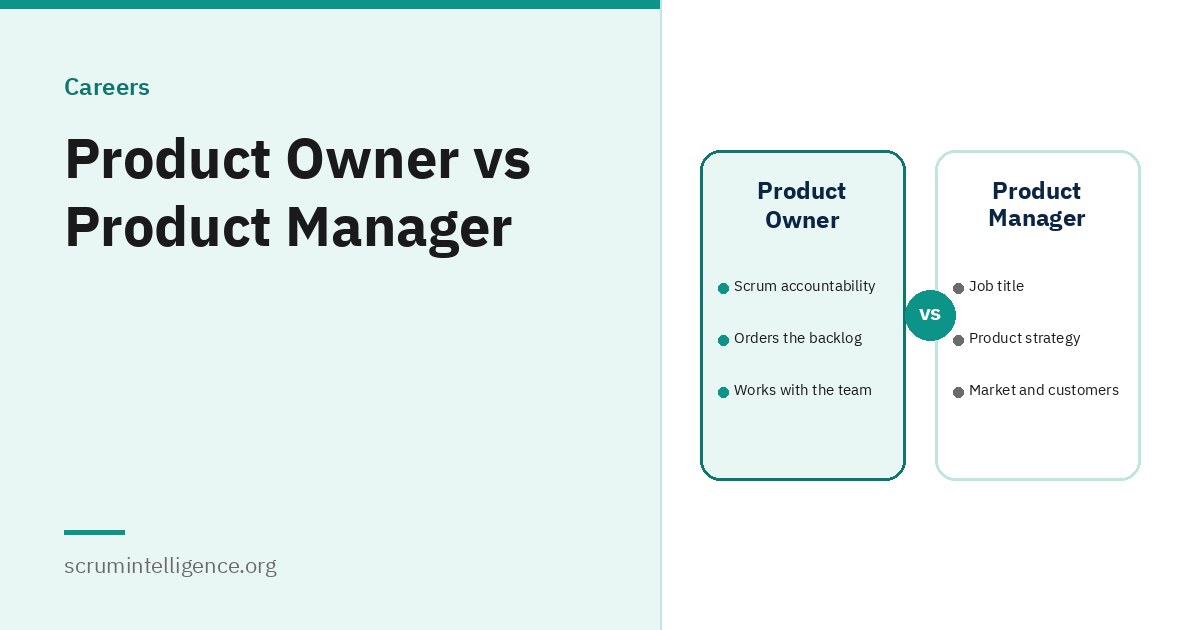
"Product Owner" and "product manager" are often used as if they mean the same thing, and many job adverts mix the two. They overlap, but they are not identical. A Product Owner is an accountability defined in Scrum. A product manager is a job title used across the technology industry, with responsibilities that vary a lot between companies. This guide explains the differences, where the roles overlap, how organisations combine them and how to decide which path suits you.
Key takeaways
- Product Owner is one of the three accountabilities in the Scrum Guide; product manager is a job title that exists with or without Scrum.
- A Product Owner is accountable for maximising the value of the product and for managing the Product Backlog.
- Product managers typically focus more broadly on market, strategy and business results, though this varies by company.
- In many organisations one person does both; in others the roles are split, which works only if the Product Owner keeps real decision-making authority.
- Neither is "better". They suit different people, products and organisations.
The quick answer
A Product Owner works within Scrum and is accountable for maximising the value delivered by a Scrum Team, mainly through the Product Goal and the Product Backlog. A product manager is responsible, more generally, for the success of a product in its market. In a company that uses Scrum, a product manager may also act as the Product Owner, or may work alongside a separate Product Owner.
In short, "Product Owner" describes an accountability in a framework, while "product manager" describes a profession.
What is a Product Owner?
The Scrum Guide, written by Ken Schwaber and Jeff Sutherland and last updated in November 2020, describes three accountabilities in a Scrum Team: the Scrum Master, the Product Owner and the Developers. According to the guide, the Product Owner is accountable for maximising the value of the product resulting from the work of the Scrum Team, and for effective Product Backlog management. That includes developing and communicating the Product Goal, creating and communicating backlog items, ordering them, and keeping the backlog transparent and understood.
The Scrum Guide also states that the Product Owner is one person, not a committee, and that the entire organisation must respect their decisions. For a full explanation, see our complete Product Owner guide and what does a Product Owner do?
What is a product manager?
Product management is a broad profession, and the exact job differs from company to company. Product managers commonly:
- Research the market, customers and competitors
- Define the product strategy and where the product should go next
- Decide which problems are worth solving
- Maintain a product roadmap and communicate it
- Work with marketing and sales on launches and positioning
- Contribute to decisions on pricing and business models
- Track business results such as adoption, retention and revenue
- Align stakeholders across the organisation
Some product managers are very close to their development teams; others focus mostly on strategy and markets. There is no single official definition of the role in the way the Scrum Guide defines the Product Owner.
Product Owner vs product manager: side by side
This comparison describes a common pattern. Individual companies vary, and in many the two roles are held by the same person.
| Product Owner | Product manager (typical) | |
|---|---|---|
| What it is | An accountability defined in the Scrum Guide | A job title and profession |
| Exists without Scrum? | No, it is part of Scrum | Yes |
| Main focus | Maximising the value of the Scrum Team's work | Product success in the market and for the business |
| Key tool | Product Backlog and Product Goal | Product strategy and roadmap |
| Works most with | The Scrum Team and stakeholders | Customers, leadership, marketing, sales and development |
| Time horizon | From the current Sprint to the Product Goal | Often longer: quarters and years |
| Typical questions | What should the team do next, and why? | Which problems and markets should we focus on? |
| Defined by | The Scrum Guide | Each organisation |
| Number per product | One Product Owner per product | Varies |
| Common certifications | Product Owner certifications | Product management courses and certificates |
The key differences explained
Origin: framework versus profession
The Product Owner exists because Scrum defines it. If a company stops using Scrum, the Product Owner accountability disappears. Product management existed long before Scrum and continues regardless of how a company develops its products.
Scope
A Product Owner's scope is set by the product and its Scrum Team or teams. A product manager's scope often reaches further into the business: pricing, positioning, partnerships and go-to-market plans. Where a Product Owner also holds these responsibilities, the difference largely disappears.
Time horizon
A Product Owner works across short and medium horizons: the next Sprint, the next few Sprints and the Product Goal. Product managers are often expected to think further ahead about markets and strategy, although good Product Owners do this too.
Authority
The Scrum Guide gives the Product Owner clear authority: the Product Owner orders the Product Backlog, only the Product Owner can cancel a Sprint, and the whole organisation must respect the Product Owner's decisions. A product manager's authority depends entirely on how their organisation defines the role.
Day-to-day work
A Product Owner typically spends a lot of time with the Scrum Team: refining backlog items, answering questions and taking part in Scrum events. A product manager may spend more time with customers, leadership and commercial teams. In practice, many people move between both kinds of work every week.
Where the roles overlap
- Both are responsible for making sure the product delivers value
- Both need a deep understanding of customers and their problems
- Both make difficult trade-offs about what to build and what not to build
- Both work closely with stakeholders and explain priorities
- Both use evidence to decide what comes next
Because the overlap is so large, many organisations simply ask one person to do both.
How organisations combine the roles
Model 1: One person does both
A product manager also acts as the Product Owner for the Scrum Team. This is common in smaller organisations and keeps decisions in one place. The challenge is time: strategy and market work can take the person away from the team, leaving the Developers waiting for answers.
Model 2: Product manager and Product Owner work together
The product manager focuses on strategy and markets, while a separate Product Owner works closely with the Scrum Team. This can work well, but it carries a risk. If the product manager makes all the decisions and the Product Owner only passes them on, the Product Owner becomes a proxy without real authority. The Scrum Guide is clear that the Product Owner is accountable for the Product Backlog and that the organisation must respect their decisions, so the split needs to leave the Product Owner with genuine decision-making power.
Model 3: Scaled frameworks
Some scaled Agile frameworks, such as SAFe, define product management and Product Owner roles at different levels, with product management working across several teams and Product Owners working with individual teams. Organisations using such frameworks follow their own role definitions.
Model 4: Several teams, one product
In Scrum itself, when several Scrum Teams work on the same product, they share one Product Owner, one Product Backlog and one Product Goal. Some organisations call this person a product manager; in Scrum terms, they are the Product Owner.
A day in each role, as an example
Real days vary a lot. As an illustration only:
A Product Owner's day
- Answering the Developers' questions about an item in the current Sprint
- A refinement session to prepare items for the next Sprint Planning
- A call with a customer about a problem they reported
- Reordering the Product Backlog after reviewing last week's usage data
- Explaining to a stakeholder why their request is not at the top yet
A product manager's day
- Reviewing a competitor's new offering and what it means for the product
- A meeting with marketing about an upcoming launch
- Updating the product roadmap for a leadership review
- Analysing customer research to decide which market segment to focus on
- Discussing a pricing change with finance and sales
The same problem, two perspectives
Imagine customers are abandoning a subscription after the first month. As an example:
- A product manager might investigate why across the whole business: pricing, onboarding, competitors, marketing promises and customer segments, and decide whether retention should become the main strategic focus.
- A Product Owner might turn that focus into a Product Goal such as "New subscribers get clear value in their first week", order the backlog around it, and work with the Developers Sprint by Sprint to test improvements and measure their effect.
When one person holds both roles, they do both parts. When the roles are split, the two need to work very closely so that strategy and backlog stay aligned.
Moving between the two roles
From Product Owner to product manager
Product Owners already have strong skills in prioritisation, stakeholder management and working with development teams. To move into broader product management, many build skills in market research, business models, pricing and go-to-market planning.
From product manager to Product Owner
Product managers moving into a Scrum environment need a solid understanding of Scrum: the Product Backlog, the Product Goal, the events and how to work with a self-managing team. Learning to work in short cycles, and to accept that plans change as the team learns, is often the biggest shift.
A short history of the two roles
Product management is much older than Scrum. Its roots are often traced to 1931, when Neil McElroy at Procter & Gamble wrote a memo proposing "brand men": people responsible for a single brand's success across marketing, sales and production. The idea spread through consumer goods and later into the technology industry, where product managers became responsible for software products and their place in the market.
The Product Owner came from Scrum. Ken Schwaber and Jeff Sutherland first presented Scrum publicly in 1995 and published the first Scrum Guide in 2010. The Product Owner was defined as the single person accountable for maximising the value of the product and managing the Product Backlog. The 2020 edition of the Scrum Guide added the Product Goal, giving the Product Owner an explicit long-term objective to develop and communicate.
Because the two roles grew from different traditions, they use different language for overlapping work, which is a large part of why they are so often confused.
Skills compared
Both roles share a core of product skills, with different emphasis:
| Skill | Product Owner | Product manager (typical) |
|---|---|---|
| Understanding customers | Essential | Essential |
| Ordering work and making trade-offs | Daily, through the Product Backlog | Regular, at the level of strategy and roadmap |
| Knowledge of Scrum | Essential | Helpful where the product uses Scrum |
| Working with developers | Very close, every Sprint | Varies from close to occasional |
| Market and competitor analysis | Useful | Usually central |
| Business models and pricing | Useful | Often part of the role |
| Stakeholder communication | Essential | Essential |
| Using data and evidence | Essential | Essential |
Making the partnership work
When a product manager and a Product Owner are different people, a few habits help them work as one:
- Agree who decides what. Write down which decisions belong to the product manager, such as market focus, and which belong to the Product Owner, such as the order of the Product Backlog. The Scrum Guide gives the Product Owner accountability for the backlog, so that should be respected.
- Share one Product Goal. The Product Goal should connect the product strategy to the team's work, and both people should be able to explain it the same way.
- Meet regularly. A short, frequent conversation keeps strategy and backlog aligned far better than occasional long reviews.
- Attend the Sprint Review together. Both see real results and hear stakeholder feedback first-hand.
- Present a united view. Stakeholders should not be able to get a different answer by asking the other person.
Signs the split is not working
- The Product Owner cannot reorder the backlog without asking the product manager.
- Stakeholders go to the product manager to get around the Product Owner's decisions.
- The Developers receive conflicting priorities from the two people.
- The Product Goal does not match the product strategy or roadmap.
- The Product Owner cannot explain why the items at the top of the backlog matter.
If these patterns appear, the roles need to be clarified, often with the help of the Scrum Master, who is accountable for helping the organisation understand and apply Scrum.
Other roles often confused with the Product Owner
Business analyst
Business analysts typically analyse processes and requirements, and many help Product Owners write and refine backlog items. A business analyst can support a Product Owner, but the accountability for value and backlog order stays with the Product Owner.
Project manager
A traditional project manager plans and tracks delivery against scope, time and budget. The Scrum Guide has no project manager accountability; product decisions sit with the Product Owner and delivery planning with the Developers. See Scrum Master vs project manager for more.
Head of product
A head of product or product director usually leads a group of product managers or Product Owners and sets the direction for a portfolio of products. They support Product Owners but should not take over the Product Owner's accountability for an individual product's backlog.
Questions to ask in a job interview
Because job titles vary so much, it helps to ask what a role really involves:
- Who decides the order of the Product Backlog?
- How much of the week is spent with the development team?
- Who sets product strategy and the roadmap?
- How are conflicting stakeholder requests resolved?
- How is success measured for this role?
- Is the company using Scrum, and if so, how many teams work on the product?
The answers will tell you whether the job is closer to a Product Owner, a product manager, or both.
Which role is right for you?
A Product Owner role may suit you if you enjoy working closely with a development team, making frequent decisions about what comes next and seeing results every Sprint. A product manager role may suit you if you are drawn to markets, strategy and business decisions across a wider organisation. Many people do both at different points in their careers, and in many companies the same job includes both.
If you are new to the Product Owner role, read how to manage a Product Backlog and Product Goal and Sprint Goal explained. If you are weighing a Scrum Master role instead, Scrum Master vs project manager explains how that role compares.
Certification
A Product Owner certification is a practical way to show employers that you understand the accountability. Product Owner Plus (Associate) covers product vision, backlog management and stakeholder alignment, and Product Owner Plus (Professional) focuses on product strategy and outcome-driven prioritisation. Exams are taken online on ExamVault by CertExpert with three attempts included, and the certificate and digital badge are valid for two years. See the certification pages for current learning paths and prices. Our CSPO guide explains another widely known option.
Frequently asked questions
Is a Product Owner the same as a product manager?
Not exactly. Product Owner is an accountability defined in Scrum; product manager is a job title. In many organisations one person does both.
Can a product manager be the Product Owner?
Yes. Many product managers act as the Product Owner for their Scrum Team, as long as they have time to work closely with the team.
Which is more senior?
Neither is automatically more senior. It depends on how the organisation defines the roles and the scope of the product.
Does Scrum have a product manager role?
No. The Scrum Guide defines three accountabilities: Scrum Master, Product Owner and Developers.
What happens if a product manager overrules the Product Owner?
The Product Owner becomes a proxy without authority, which the Scrum Guide warns against. For a Product Owner to succeed, the whole organisation must respect their decisions.
Do product managers need Scrum knowledge?
If their product is developed with Scrum, understanding it helps them work effectively with the Product Owner and the Scrum Team.
Can I move from Product Owner to product manager?
Yes. Many do, often by building skills in market research, strategy and business models.
Which role should I choose?
Choose the Product Owner path if you enjoy working closely with a development team and frequent product decisions; choose product management if you are drawn to markets and business strategy.