
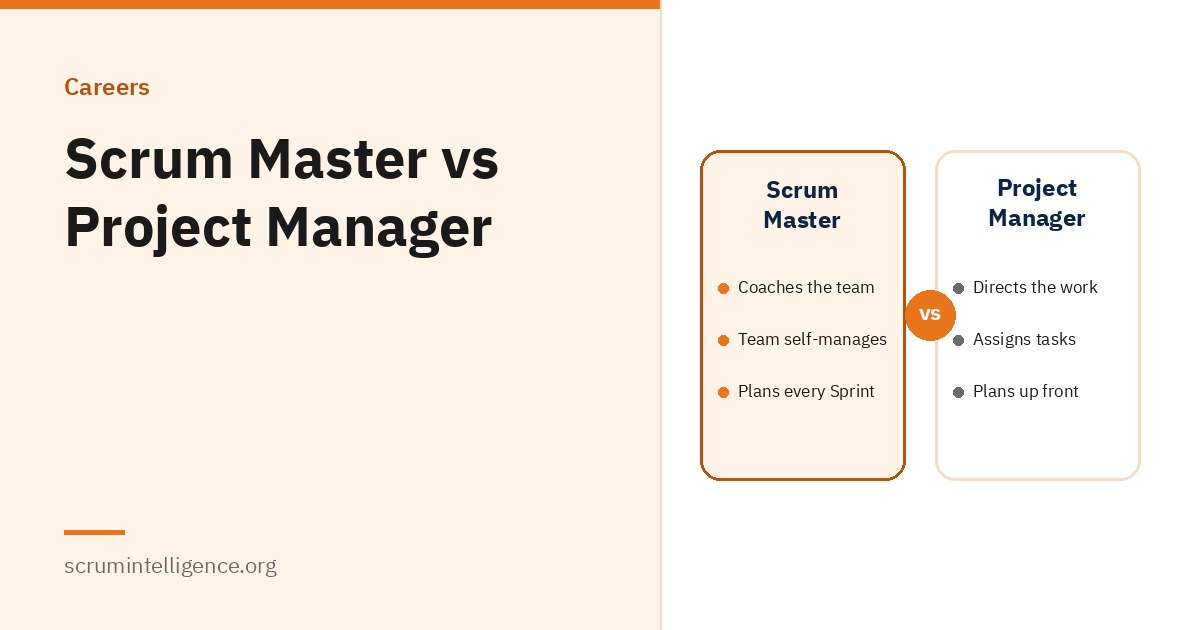
Scrum Masters and project managers both help work get delivered, so the two roles are often confused. Some organisations even rename their project managers as Scrum Masters without changing how they work, and then wonder why Scrum does not deliver what they hoped. The roles are built on different ideas about how work should be organised. This guide explains the real differences, where the roles overlap, and how to move from one to the other.
Key takeaways
- Scrum defines three accountabilities: Scrum Master, Product Owner and Developers. There is no project manager in Scrum.
- A traditional project manager plans and directs the work; a Scrum Master coaches a self-managing team.
- A project manager is usually measured on delivering agreed scope on time and on budget; a Scrum Master is accountable for the team's effectiveness.
- The roles overlap in removing obstacles, working with stakeholders and caring about value.
- Many project managers make strong Scrum Masters, but they need to change how they lead.
The quick answer
A project manager is typically responsible for delivering a defined project: planning the work, assigning tasks, tracking progress, managing risk, and keeping scope, schedule and budget under control. A Scrum Master is accountable for establishing Scrum and for the Scrum Team's effectiveness. They do not plan or assign the team's work. Instead, they help a self-managing team work well, and help the wider organisation support it.
In short: a project manager manages the work, while a Scrum Master helps the team manage its own work.
Why there is no project manager in Scrum
The Scrum Guide, written by Ken Schwaber and Jeff Sutherland and last updated in November 2020, describes three accountabilities in a Scrum Team: the Scrum Master, the Product Owner and the Developers. Responsibilities that a project manager would traditionally hold are spread across these three:
- What to build and in what order sits with the Product Owner, who is accountable for maximising the value of the product and managing the Product Backlog.
- How to do the work and who does which task sits with the Developers, who are self-managing.
- How effectively the team works and uses Scrum sits with the Scrum Master.
That does not mean project managers have no place in an organisation that uses Scrum. It means the Scrum Master is a different job, and simply renaming a project manager does not create one. For a full description of the role, see what does a Scrum Master do?
What a project manager typically does
Project management covers a wide range of approaches, and many project managers today use Agile methods. In a traditional, plan-driven approach, a project manager commonly:
- Defines the project's scope, schedule and budget with the sponsor
- Breaks the work down into tasks and builds a detailed plan
- Assigns tasks to team members and tracks their progress
- Manages risks, issues and dependencies, often using a risk register
- Handles change through a formal change-control process
- Reports status to sponsors and stakeholders
- Closes the project when the agreed scope is delivered
This approach works well when the work is predictable: when requirements are known up front and unlikely to change. Scrum was designed for the opposite situation, complex work where the best solution only becomes clear as the team learns.
What a Scrum Master does
According to the Scrum Guide, a Scrum Master serves three groups:
- The Scrum Team: coaching self-management, helping the team create Increments that meet the Definition of Done, causing the removal of impediments, and making sure Scrum events are productive and kept within their timebox.
- The Product Owner: helping with techniques for defining the Product Goal and managing the Product Backlog, and facilitating collaboration with stakeholders.
- The organisation: leading, training and coaching Scrum adoption, and removing barriers between stakeholders and Scrum Teams.
Our complete Scrum Master guide explains the role and the Scrum framework in depth.
Scrum Master vs project manager: side by side
| Scrum Master | Project manager (traditional approach) | |
|---|---|---|
| Main focus | The team's effectiveness and the use of Scrum | Delivering the project on scope, time and budget |
| Who decides how work is done | The Developers, who manage themselves | Often the project manager, working with the team |
| Assigning tasks | Does not assign tasks | Usually assigns and tracks tasks |
| Planning | Short cycles, re-planned every Sprint | Usually a detailed plan made up front |
| Handling change | Expected; the Product Backlog is updated | Managed through a change-control process |
| Deciding priorities | The Product Owner orders the Product Backlog | Often agreed between the project manager and sponsor |
| Managing risk | Short Sprints and frequent inspection limit risk | Risk register and mitigation plans |
| Reporting | Transparency through the artifacts and the Sprint Review | Regular status reports |
| Success looks like | A team that delivers valuable, Done Increments and keeps improving | A project delivered as agreed |
The project manager column describes a common traditional approach. Individual project managers and organisations vary, and many already work in more adaptive ways.
The key differences explained
Authority and decision-making
A project manager usually has formal authority over the plan and often over who does what. A Scrum Master has no such authority over the team's work. Scrum Teams are self-managing, which means the team decides internally who does what, when and how. The Scrum Master's influence comes from coaching, facilitation and expertise in Scrum, not from control.
Planning and change
Traditional project management invests heavily in planning at the start and then manages deviations from that plan. Scrum plans continuously. Each Sprint begins with Sprint Planning, and the Product Backlog is updated as the team and stakeholders learn. Change is not treated as a problem to control but as information to act on. The artifacts involved are explained in Scrum artifacts explained.
How success is measured
A project manager is often judged on whether the project met its agreed scope, schedule and budget. A Scrum Master is accountable for the team's effectiveness: whether the team regularly delivers usable Increments that meet the Definition of Done, whether impediments get resolved, and whether the team keeps improving how it works.
Relationship with the team
Team members in a traditional project often report progress to the project manager. In Scrum, the Developers inspect their own progress every day at the Daily Scrum, and the Scrum Master supports rather than supervises. This difference in relationship is one of the hardest parts of the transition for former project managers.
Managing risk
Project managers typically identify and track risks formally. Scrum handles risk differently: Sprints of one month or less limit the cost of going in the wrong direction, and frequent inspection at the Sprint Review and Retrospective means problems surface early. The Scrum Guide notes that shorter Sprints limit the risk of cost and effort to a smaller time frame.
Reporting
Where a project manager produces status reports, Scrum relies on transparency. The Product Backlog, the Sprint Backlog and the Increment show where things stand, and the Sprint Review gives stakeholders a regular chance to see working results and give feedback. A Scrum Master often helps stakeholders use these sources instead of asking for separate reports.
Where the roles overlap
- Both remove obstacles that slow the work down
- Both communicate with stakeholders and manage expectations
- Both care about the team delivering real value
- Both need strong facilitation and people skills
The difference is less about what they care about and more about how they act on it. A project manager usually directs; a Scrum Master coaches the team to direct itself.
Where project managers fit in organisations that use Scrum
Because the Scrum Guide does not include a project manager, organisations handle existing project managers in different ways. Common paths include:
- Becoming a Scrum Master, for those who enjoy coaching and facilitation
- Becoming a Product Owner, for those drawn to decisions about value and priorities, provided the organisation gives them real authority over the Product Backlog
- Coordinating across teams or programmes, such as managing dependencies, contracts or vendors that sit outside any single Scrum Team
- Continuing in project management for work that is predictable and better suited to a plan-driven approach
Can one person be both?
It is possible, but it creates tension. A Scrum Master's job is to support self-management, while a traditional project manager is expected to control the plan and assign work. When one person holds both, the team often slips back into waiting for instructions, and the benefits of Scrum fade. If an organisation genuinely needs both roles, it usually works better with two people who understand the boundary between them.
What about hybrid approaches?
Some organisations combine plan-driven project management at the programme level with Scrum at the team level. This can work, but it needs care. If the programme plan fixes the scope of every Sprint in advance, the team loses the ability to adapt, and Scrum becomes a set of meetings rather than a way of working. The Scrum Guide notes that Scrum is free and offered as is, and that the framework is immutable: implementing only parts of it is possible, but the result is not Scrum.
Moving from project manager to Scrum Master
Skills that transfer well
- Working with stakeholders and managing expectations
- Spotting risks and dependencies early
- Facilitating meetings and keeping discussions on track
- Understanding how the organisation works and who makes decisions
Mindset shifts you will need
- From directing the team to coaching it
- From owning the plan to letting the Developers own their Sprint plan
- From managing change requests to welcoming change through the Product Backlog
- From producing status reports to making work transparent through the Scrum artifacts
- From solving problems yourself to helping the team solve them
Practical steps
- Study the Scrum Guide carefully, and read about the purpose behind each event in the five Scrum events explained.
- Take structured training and a certification to test your understanding. Our Scrum Master exam study plan can help.
- Practise facilitating a Retrospective using the approach in how to run a Sprint Retrospective.
- Ask for feedback from the team on whether you are helping or directing.
Common pitfalls
- Continuing to assign tasks out of habit
- Running the Daily Scrum as a status meeting
- Protecting a fixed plan instead of the Sprint Goal
- Answering every question instead of asking the team what it thinks
A day in the life: project manager vs Scrum Master
Real days vary a lot, and neither the Scrum Guide nor any project management approach prescribes a timetable. As an illustration, here is how the two roles might spend a typical day.
A project manager's day, as an example
- Reviewing the project plan and updating the schedule after yesterday's progress
- Checking in with team members on the status of their assigned tasks
- Updating the risk register after a supplier warns of a delay
- Preparing a weekly status report for the project sponsor
- Assessing a change request and its impact on cost and timeline
- Chairing a steering meeting to agree the next project milestone
A Scrum Master's day, as an example
- Attending the Daily Scrum, run by the Developers, and noting an impediment that came up
- Following up with another team whose delay is blocking the Sprint Goal
- Coaching a Developer who is unsure how to raise a concern with the team
- Helping the Product Owner prepare for a backlog refinement session
- Explaining to a manager why adding new work mid-Sprint would endanger the Sprint Goal
- Planning a Retrospective format to explore why work keeps being carried over
The project manager's day centres on the plan and on keeping the project under control. The Scrum Master's day centres on the team, on impediments and on helping the organisation work with Scrum.
The same problem, two approaches
Here is an example of how each role might handle the same situation. Halfway through a piece of work, an important stakeholder asks for a new feature that was not in the original plan.
A traditional project manager might:
- Log the request as a formal change request
- Assess its impact on scope, schedule and budget
- Take it to the sponsor or a change board for approval
- If approved, update the project plan and re-baseline the schedule
- Assign the new tasks to team members
In a Scrum Team:
- The Scrum Master makes sure the request goes to the Product Owner, not straight to the Developers
- The Product Owner decides whether it belongs in the Product Backlog and where it should be ordered
- If it does not fit the current Sprint Goal, it is considered for a future Sprint, often the next one
- If it is truly urgent and makes the current Sprint Goal obsolete, the Product Owner can decide to cancel the Sprint, though this should be rare
- At the next Sprint Planning, the Developers plan how to do the work
Both approaches take the request seriously. The difference is that Scrum expects changes like this and has a built-in place to handle them every Sprint, while a plan-driven approach treats them as exceptions to the plan.
Scrum Master vs Product Owner vs project manager
People moving from project management are often unsure whether their skills fit the Scrum Master or the Product Owner accountability. This comparison may help:
| Scrum Master | Product Owner | Project manager (traditional) | |
|---|---|---|---|
| Main question | How well is the team working? | What should we build next, and why? | Are we on track with the plan? |
| Key responsibility | Team effectiveness and use of Scrum | Maximising product value and managing the Product Backlog | Delivering agreed scope on time and on budget |
| Works mainly with | The team, the Product Owner and the organisation | Stakeholders, customers and the Developers | Sponsors, stakeholders and the project team |
If you enjoy deciding priorities and talking to customers, the Product Owner role may suit you. If you enjoy helping people work together better, the Scrum Master role may be the better fit.
Signs of a project manager with a Scrum Master title
When an organisation renames its project managers without changing how they work, some patterns tend to appear:
- The "Scrum Master" assigns tasks and decides who works on what
- The Daily Scrum is a status update delivered to the Scrum Master
- The Sprint scope is fixed in advance by a long-term plan, leaving no room to adapt
- Stakeholders still receive detailed status reports instead of attending the Sprint Review
- Retrospectives are skipped when deadlines are tight
None of these makes the person a bad professional. They simply show that the organisation is using Scrum words without Scrum's way of working. Helping the organisation see this is itself part of the Scrum Master's accountability.
Which role is right for you?
Neither role is better; they suit different people and different kinds of work. A Scrum Master role may suit you if you enjoy coaching, are comfortable leading without formal authority, and like helping a team grow more independent over time. Project management may suit you better if you enjoy structured planning, clear ownership of scope and budget, and work where requirements are well understood in advance. Many professionals move between the two during their careers. How to start a career as a Scrum Master sets out the route into the role step by step.
Get certified
Scrum Master Plus (Associate) includes 16 hours of training and an online exam on ExamVault by CertExpert, with three attempts included. The certificate and digital badge are valid for two years. If you are drawn more to decisions about what to build, Product Owner Plus (Associate) covers product vision and backlog management.
Frequently asked questions
Is a Scrum Master a project manager?
No. A Scrum Master does not plan or assign the team's work. They are accountable for establishing Scrum and for the team's effectiveness, and they lead by coaching and facilitating.
Is there a project manager in Scrum?
No. The Scrum Guide defines three accountabilities: the Scrum Master, the Product Owner and the Developers. Traditional project management responsibilities are shared between them.
Can a project manager become a Scrum Master?
Yes. Many do, and their experience with stakeholders and risk is valuable. The biggest change is moving from directing the team to coaching a self-managing team.
Which is better, Scrum Master or project manager?
Neither is better in general. Scrum suits complex work where requirements change; traditional project management suits predictable work. The right role depends on the work and on what you enjoy.
Does a Scrum Master manage the budget?
Budget management is not one of the Scrum Master's accountabilities in the Scrum Guide. Organisations decide who handles budgets, and it varies.
Who manages scope in Scrum?
The Product Owner orders the Product Backlog, which decides what comes next. During a Sprint, the Developers and the Product Owner can clarify and renegotiate scope, as long as the Sprint Goal is not endangered.
Do Scrum Teams need a project manager?
Scrum does not require one. Some organisations still use project managers for work that spans several teams, contracts or vendors.
Can a project manager become a Product Owner?
Yes, if they are given real authority over the Product Backlog. The Scrum Guide notes that for a Product Owner to succeed, the whole organisation must respect their decisions.