
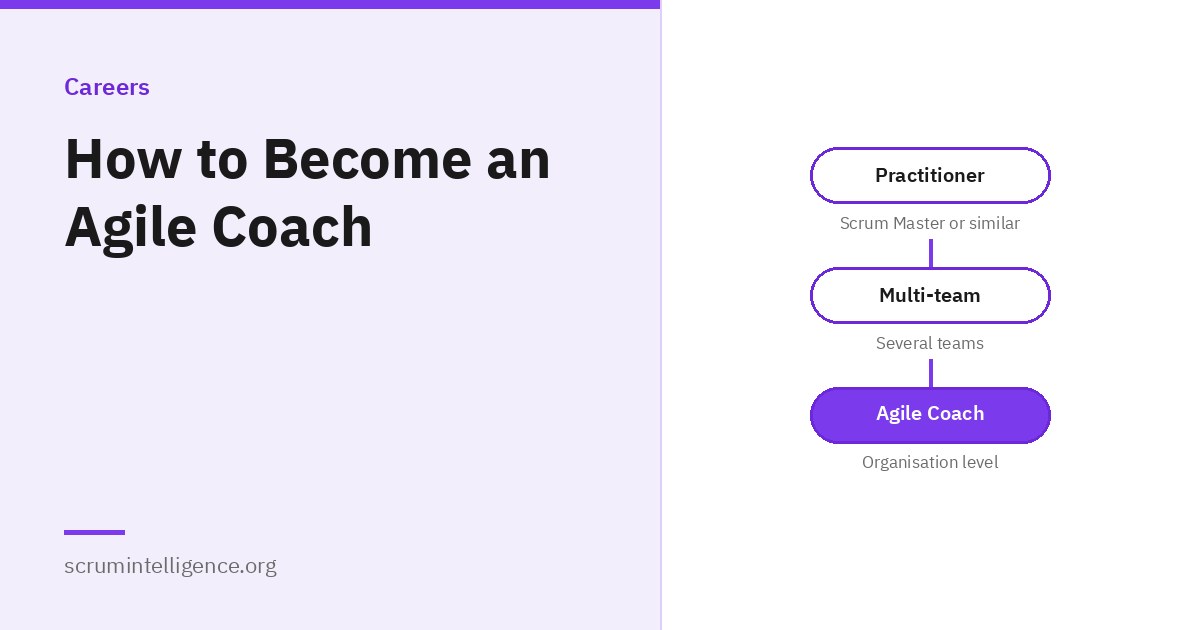
Agile Coach is a natural next step for many experienced Scrum Masters, Product Owners and agile team members. It is also a role with no single official definition, which makes the path into it less obvious than for roles defined in the Scrum Guide. This guide sets out a practical, step-by-step path: the experience and skills you need, how to develop them, which credentials exist, and how to land your first coaching role.
Key takeaways
- Most Agile Coaches start with hands-on experience, often as a Scrum Master or Product Owner.
- Coaching skills are distinct from agile knowledge; professional coaching, facilitation and teaching all need to be developed deliberately.
- Understanding organisations and systems becomes more important as your scope grows.
- Credentials can help, but employers value evidence of real coaching impact most.
- Coaching other Scrum Masters is one of the best ways to start.
What does an Agile Coach do?
Agile Coaches help teams, leaders and organisations adopt and improve agile ways of working. They often coach several teams and their Scrum Masters and Product Owners, work with managers on agile leadership, and support organisation-wide change. The Scrum Guide does not define the role, so responsibilities vary by organisation. For how it compares with the Scrum Master accountability, see Agile Coach vs Scrum Master.
Is the role right for you?
Agile coaching may suit you if you:
- Enjoy helping others grow more than doing the work yourself
- Are comfortable with ambiguity and slow, gradual change
- Can influence people without formal authority
- Are curious about how organisations work, not just teams
- Can stay patient when people resist change
Step 1: Build real agile experience
Credibility as a coach comes from having done the work. Most Agile Coaches have spent several years as a Scrum Master, Product Owner, developer or team lead in agile teams. Aim to experience both success and difficulty: a team that struggled and improved teaches more than one that was always easy. Our complete Scrum Master guide and complete Product Owner guide cover the foundations.
Step 2: Broaden beyond one framework
Agile Coaches help organisations choose approaches that fit their context, so they need breadth. Learn Kanban and flow, Lean thinking, Extreme Programming practices and product management basics. Our complete Kanban guide and Agile vs Scrum are good starting points.
Step 3: Learn professional coaching
Coaching is a distinct skill: helping people find their own answers through listening and questions, rather than advising them. The International Coaching Federation (ICF), a professional body for coaches, publishes a set of core competencies, including maintaining presence, listening actively, evoking awareness and facilitating client growth. Studying these competencies and practising them with feedback is one of the best investments an aspiring Agile Coach can make.
Step 4: Master facilitation
Much of an Agile Coach's work happens in groups: workshops, retrospectives, planning sessions and leadership meetings. Good facilitation helps groups think well and reach decisions. The International Association of Facilitators is one professional body focused on facilitation skills. Practise facilitating different kinds of sessions and ask for feedback each time.
Step 5: Learn how organisations work
As your scope grows, problems increasingly come from structures, incentives and culture rather than individual teams. Systems thinking helps: Peter Senge's 1990 book The Fifth Discipline is a well-known introduction. Learn about organisational change, including models such as Kotter's eight steps and ADKAR, covered in our agile transformation guide, and about agile leadership, covered in our complete agile leadership guide.
Step 6: Develop teaching and training skills
Agile Coaches often design and run training. Effective training is interactive, not a long lecture. Sharon Bowman's 2008 book Training from the Back of the Room is widely used by agile trainers for designing brain-friendly, participative learning.
Step 7: Coach other Scrum Masters
One of the best ways to start coaching is to support other Scrum Masters: newer ones in your organisation, a community of practice, or peers who want a sounding board. It builds coaching skills and evidence of impact beyond a single team.
Step 8: Build your reputation
- Share what you learn internally through talks, workshops or written guides
- Take part in local agile communities and events
- Write about real challenges and what you learned
- Seek feedback from the people you coach and use it
Step 9: Consider credentials
Several organisations offer coaching-related credentials. Examples include ICAgile's agile coaching certifications, professional coaching credentials from the International Coaching Federation, and advanced coaching paths offered by Scrum Alliance. Requirements, costs and recognition vary, so research each carefully. Credentials can help you get noticed, but employers usually look most closely at your experience and the results of your coaching.
Scrum Intelligence's Scrum Master Plus (Professional) focuses on coaching, facilitation and organisational change, and Scrum Leader Plus covers coaching multiple teams and cross-team dependencies. Both exams are taken online on ExamVault by CertExpert with three attempts included, and certificates and digital badges are valid for two years. See the certification pages for current learning paths and prices.
Step 10: Find your first coaching role
An internal move is often the easiest route: an organisation that already knows your work may create a coaching role or ask you to support several teams. Other routes include team-level coaching roles, joining a central agile team, or working alongside an experienced coach. Be clear in your CV and interviews about the teams you have helped, what changed and how you know.
Coaching, mentoring, teaching and consulting
Agile Coaches move between these ways of helping. Knowing the difference, and choosing deliberately, is a core skill:
| Stance | What it means | When it helps |
|---|---|---|
| Coaching | Helping people find their own answers through questions and listening | When people have the knowledge but need clarity or confidence |
| Mentoring | Sharing your own experience and advice | When people are facing something you have faced before |
| Teaching | Explaining concepts and practices | When people lack knowledge they need |
| Consulting | Providing recommendations or solutions as an expert | When a decision is needed quickly and expertise is missing |
| Facilitating | Helping a group work through a discussion or decision | When a group needs structure to think and decide together |
A competency self-assessment
Lyssa Adkins and Michael Spayd's Agile Coaching Competency Framework groups coaching skills into areas. Rate yourself from 1 (beginner) to 5 (confident) on each, and focus on the lowest:
| Area | What confident looks like |
|---|---|
| Teaching | You can design and run engaging, interactive training |
| Mentoring | People seek your advice and find it useful |
| Professional coaching | You help people reach their own insights through questions and listening |
| Facilitating | You can guide groups to good decisions, even when there is conflict |
| Technical mastery | You understand engineering practices that support agility |
| Business mastery | You understand how product and business decisions create value |
| Transformation mastery | You can support change across teams and leadership |
Ethics and boundaries
Coaching involves trust. Good Agile Coaches keep confidences, are clear about who their client is, avoid taking sides in conflicts, and know when an issue needs a different kind of help, such as HR support or professional counselling. Being open about the limits of your role builds credibility.
A 12-month development plan
As an illustration, a Scrum Master aiming for an Agile Coach role might plan a year like this:
- Months 1 to 3: study professional coaching basics and practise coaching conversations with one or two colleagues, asking for feedback each time.
- Months 4 to 6: learn Kanban and flow in depth, and introduce one flow practice with your own team.
- Months 7 to 9: start mentoring a newer Scrum Master, and facilitate a workshop for another team or for managers.
- Months 10 to 12: join or start a community of practice, share what you have learned, and discuss a coaching role with your manager, backed by examples of your impact.
Finding a mentor and getting supervision
Experienced coaches often work with a mentor coach or supervisor: someone who helps them reflect on their coaching, spot blind spots and handle difficult situations. Professional coaching bodies, including the International Coaching Federation, include mentor coaching in some of their credential paths. Even informally, regular conversations with a more experienced coach speed up development significantly.
Building a coaching portfolio
A simple portfolio helps you explain your impact:
- Short case studies: the situation, what you did, what changed and what you learned
- Workshops and training you designed and ran, with participant feedback
- Examples of teams or people you supported over time
- Articles or talks you have shared
Protect confidentiality: describe situations without naming people or sensitive details.
Internal versus external coaching
Internal coaches work inside one organisation. They know its people and history and can support change over a long period. External coaches work with several organisations, bringing a wider range of experience and an outside perspective, usually for shorter periods. Many coaches start internally, where they can build a track record, before choosing whether to move to external work.
A typical first coaching engagement
As an illustration, a new Agile Coach might be asked to support three teams for six months:
- First weeks: meet each team, its Scrum Master and Product Owner, observe their events and listen to what people find difficult.
- Agree focus: with each team, agree one or two areas where coaching would help most, such as refinement or stakeholder collaboration.
- Coach and support: run workshops where useful, coach the Scrum Masters individually and help teams try small experiments.
- Work upward: raise organisational impediments with leaders, backed by specific examples.
- Review: every few weeks, check with each team what has changed and adjust the focus.
Questions to reflect on before you start
- Who is my client: the team, the Scrum Master, the manager or the organisation?
- What does success look like for them, and how will we know?
- Where am I likely to be tempted to give answers instead of coaching?
- What will I do if what the team needs conflicts with what a manager wants?
- Who can support me when I get stuck?
Common mistakes aspiring coaches make
- Telling instead of coaching. Giving answers feels helpful, but it can stop people learning.
- Pushing one framework everywhere. Every context is different.
- Staying at team level only. Many problems sit in the wider organisation.
- Neglecting your own development. Coaches need coaching and feedback too.
- Collecting credentials instead of experience. Impact matters more than certificates.
Frequently asked questions
How do I become an Agile Coach?
Build hands-on agile experience, broaden your knowledge beyond one framework, develop coaching, facilitation and teaching skills, learn how organisations work and start by coaching other Scrum Masters.
Do I need to be a Scrum Master first?
Not necessarily, but most Agile Coaches have significant hands-on experience in agile teams, often as Scrum Masters.
How long does it take to become an Agile Coach?
It varies, but most coaches have several years of agile experience before moving into the role.
What skills does an Agile Coach need?
Professional coaching, facilitation, teaching and mentoring, plus deep agile knowledge and an understanding of business and organisational change.
Are there Agile Coach certifications?
Yes. Examples include ICAgile's agile coaching certifications, ICF professional coaching credentials and Scrum Alliance's advanced coaching paths.
What is the difference between coaching and mentoring?
Coaching helps people find their own answers; mentoring shares your own experience and advice.
Can I become an Agile Coach without a technical background?
Yes. Many coaches come from non-technical backgrounds, although understanding how teams build products helps.
What is the Agile Coaching Competency Framework?
A framework described by Lyssa Adkins and Michael Spayd that groups agile coaching skills into areas such as teaching, mentoring, professional coaching, facilitating and technical, business and transformation mastery.