
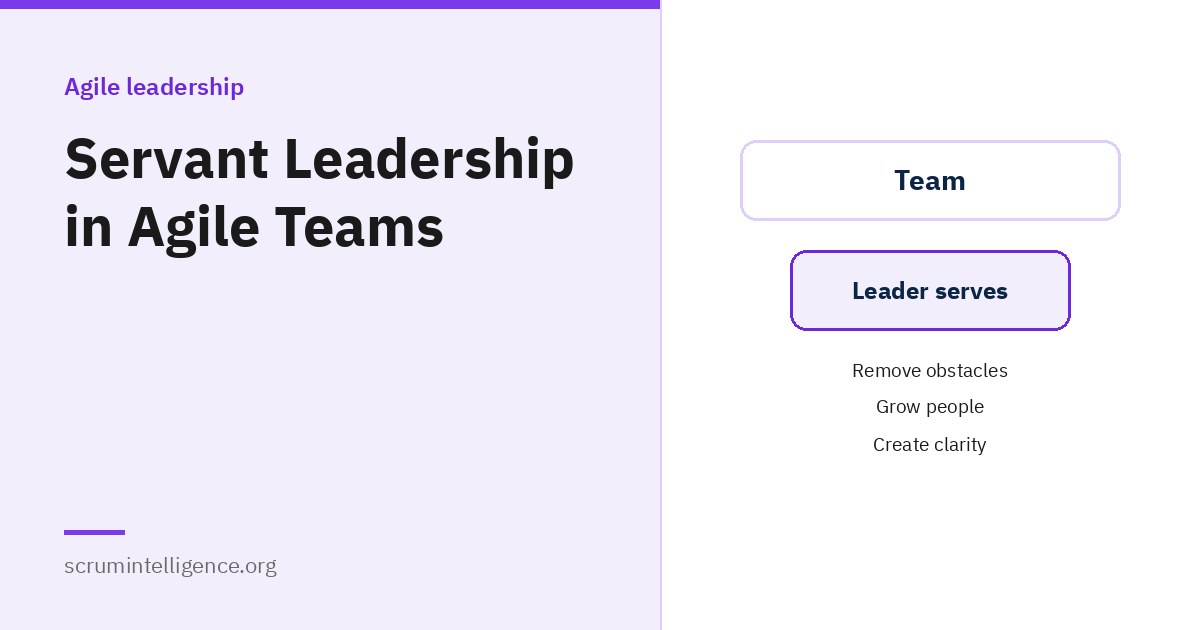
Servant leadership is one of the most talked-about ideas in agile work, and one of the most misunderstood. Some people hear "servant" and imagine a leader who fetches coffee and never makes a decision. Others treat it as a slogan with little practical meaning. In fact, servant leadership is a well-developed idea with a clear origin, and it describes a demanding way of leading. This guide explains where servant leadership comes from, what it really means, how it appears in Scrum and how to practise it day to day.
Key takeaways
- Robert K. Greenleaf introduced the term servant leadership in his 1970 essay The Servant as Leader.
- A servant leader's first aim is to help others grow and succeed; leadership follows from that.
- The 2017 Scrum Guide called the Scrum Master a "servant-leader"; the 2020 edition describes Scrum Masters as true leaders who serve the Scrum Team and the organisation.
- Servant leadership is not passive: servant leaders set direction, hold standards and make hard calls when needed.
- It is practised through listening, coaching, removing obstacles and developing people.
Where servant leadership comes from
Robert K. Greenleaf spent much of his career at AT&T, working on management research and development. In 1970 he published an essay called The Servant as Leader, which introduced the term servant leadership. He later founded what became the Greenleaf Center for Servant Leadership.
Greenleaf said the idea came to him after reading Hermann Hesse's novel Journey to the East. In the story, a group of travellers is supported by Leo, a servant who keeps their spirits up. When Leo disappears, the group falls apart. Later, the narrator discovers that Leo was in fact the head of the order that sponsored the journey: its great and noble leader. For Greenleaf, the lesson was that great leaders are servants first.
Greenleaf's test
Greenleaf proposed a test for whether someone is a servant leader. In essence, he asked: do the people served grow as persons? While being served, do they become healthier, wiser, freer, more autonomous and more likely to become servants themselves? He also asked how the least privileged in society are affected. The test focuses on the effect on others, not on the leader's intentions.
The characteristics of servant leaders
Larry Spears, who led the Greenleaf Center for many years, identified ten characteristics of servant leaders from Greenleaf's writings:
| Characteristic | What it looks like in an agile team |
|---|---|
| Listening | Paying full attention in conversations and Retrospectives, and hearing what is not said |
| Empathy | Understanding people's perspectives and assuming good intent |
| Healing | Helping people and relationships recover after conflict or difficult periods |
| Awareness | Noticing patterns in the team and in oneself |
| Persuasion | Influencing through reasoning rather than authority |
| Conceptualisation | Seeing the bigger picture and long-term goals |
| Foresight | Anticipating likely consequences from past lessons and present realities |
| Stewardship | Holding the team and organisation in trust for the greater good |
| Commitment to the growth of people | Actively developing each person's skills and confidence |
| Building community | Creating a sense of belonging and shared purpose |
Servant leadership in Scrum
For several years, the Scrum Guide described the Scrum Master as a "servant-leader for the Scrum Team". In the November 2020 edition, the wording changed: Scrum Masters are now described as true leaders who serve the Scrum Team and the larger organisation. The change emphasised that the Scrum Master is genuinely a leader, not only a helper, while keeping the idea of service.
The Scrum Guide describes the Scrum Master serving three groups: the Scrum Team, the Product Owner and the organisation. Serving includes coaching self-management, helping remove impediments, supporting the Product Owner with backlog techniques, and leading, training and coaching the organisation in its Scrum adoption. See what does a Scrum Master do? for more.
What servant leadership is not
- Not servility. A servant leader serves the team's growth and goals, not every individual request.
- Not a team assistant. Booking rooms and taking notes can sometimes help, but they are not the core of the role.
- Not avoiding decisions. Servant leaders make decisions when they are needed, especially about the framework, standards and safety.
- Not avoiding conflict. Serving a team sometimes means raising uncomfortable issues.
- Not permissiveness. Servant leaders hold high standards and expect accountability.
A useful way to think about it: servant leaders serve the team's needs, which are not always the same as its wishes.
Servant leadership in practice
For Scrum Masters
- Asking the team how it wants to solve a problem, rather than providing the answer
- Following up on impediments until they are resolved, including those outside the team
- Protecting the team's focus during the Sprint
- Coaching individuals who are learning new skills or roles
- Facilitating Retrospectives that lead to real change; see how to run a Sprint Retrospective
For Product Owners
- Serving customers by deeply understanding their needs
- Serving the Developers by being available and explaining the why behind each item
- Serving stakeholders by being transparent about priorities and trade-offs
See our complete Product Owner guide.
For managers
- Removing organisational obstacles teams cannot remove themselves
- Creating development opportunities and giving regular, constructive feedback
- Delegating decisions and supporting teams when those decisions carry risk
- Asking "what do you need from me?" regularly, and acting on the answer
Balancing service with direction
Servant leadership does not mean never giving direction. Paul Hersey and Ken Blanchard's situational leadership model, developed in the late 1960s and 1970s, suggests that effective leaders adapt their style to the readiness of the people they lead: more direction for people new to a task, more support and delegation as competence and confidence grow. The same applies in agile teams. A brand-new team may need a Scrum Master who teaches Scrum clearly and sets boundaries; a mature team may need a Scrum Master who mostly asks questions and removes organisational obstacles. Serving well means knowing which the team needs now.
Servant leadership compared with other styles
| Style | Main focus | Typical behaviour |
|---|---|---|
| Command and control | Compliance with the leader's plan | Directs tasks, checks work closely |
| Transformational | Inspiring people toward a shared vision | Communicates a compelling vision, challenges people to exceed expectations |
| Situational | Matching style to people's readiness | Directs, coaches, supports or delegates as needed |
| Servant | The growth and wellbeing of others | Listens, removes obstacles, develops people, builds community |
Transformational leadership was described by James MacGregor Burns in 1978 and developed further by Bernard Bass. In practice, good agile leaders often combine elements of several styles, with service as the foundation.
Practical habits of servant leaders
- Ask before you tell. In conversations, begin with a question.
- Hold regular one-to-ones. Ask what helps, what gets in the way and how each person wants to grow.
- Keep an impediment list. Track obstacles the team raises and report back on each.
- Give credit publicly and take responsibility privately.
- Admit your own mistakes. It makes it safer for others to do the same.
- Protect time for learning. Make sure improvement work is not always crowded out.
How to tell if servant leadership is working
Following Greenleaf's test, the best evidence is in the people being served:
- Team members are growing in skill and confidence.
- The team solves more problems without needing the leader.
- People raise problems early and openly.
- Team members start supporting and developing each other.
- Delivery and customer outcomes improve over time.
Servant leadership in everyday Scrum events
Sprint Planning
A servant leader helps the team plan well rather than planning for it: making sure the Product Backlog is ready, keeping the discussion on the Sprint Goal and letting the Developers decide how much they can take on.
Daily Scrum
The Daily Scrum belongs to the Developers. A servant leader makes sure it happens, listens for impediments, and follows up afterwards rather than running the meeting or turning it into a status report.
Sprint Review
Serving here means bringing the right stakeholders, creating space for honest feedback and helping the team and Product Owner turn that feedback into decisions.
Sprint Retrospective
A servant leader creates the safety for people to speak openly, facilitates without steering, and makes sure agreed improvements actually happen.
Coaching questions servant leaders use
- What would you like to achieve?
- What have you already tried?
- What options do you see?
- What is getting in your way?
- What support do you need from me?
- What would you do if you knew you could not fail?
- What did you learn from that?
Good coaching questions are open, short and genuinely curious. They help people find their own answers, which builds their ability to solve the next problem without help.
A worked example: serving a struggling team
As an illustration, imagine a Scrum Master joining a team that has missed its Sprint Goal three Sprints in a row. Morale is low and the team blames unclear requirements.
- Listen first: the Scrum Master holds one-to-one conversations and learns that the Product Owner is rarely available and that items often arrive mid-Sprint from a senior manager.
- Help the team see the pattern: in the Retrospective, the team maps where time went and sees how much was spent on unplanned work.
- Remove what the team cannot: the Scrum Master raises the mid-Sprint requests with the manager and agrees that new requests go through the Product Owner.
- Support the Product Owner: the Scrum Master helps set up regular refinement sessions that fit the Product Owner's schedule.
- Let the team own its improvements: the team decides to limit work in progress and to set a clearer Sprint Goal.
Over the following Sprints, the team starts meeting its Sprint Goals more often. The Scrum Master did not solve the problems alone; they helped the team and organisation solve them together.
Servant leadership and accountability
Serving a team does not mean lowering expectations. Servant leaders hold teams to high standards, such as a demanding Definition of Done, honest transparency and follow-through on commitments. The difference is how they do it: by helping people meet those standards rather than punishing them for missing them. Giving clear, honest feedback is itself an act of service, because it helps people grow.
Servant leadership in hierarchical cultures
In organisations or cultures with strong hierarchy, people may expect leaders to give instructions and may feel uncomfortable taking decisions themselves. Servant leaders in these settings often need to be explicit: saying clearly which decisions the team can make, showing that mistakes will not be punished, and building trust step by step. Change usually comes gradually, through consistent behaviour over months rather than a single announcement.
Common challenges
"The organisation expects me to direct."
Explain the approach to your own managers, and show results. Invite them to Sprint Reviews so they see what the team delivers.
"The team wants me to make all the decisions."
Teams used to being directed may need time. Delegate gradually, starting with lower-risk decisions, and support them when they get things wrong.
"I end up doing everything for the team."
That is helping, not serving. Ask whether your action builds the team's own ability. If not, coach instead.
Learn more
Our complete agile leadership guide covers the wider picture, and the complete Scrum Master guide explains the role most associated with servant leadership in Scrum. Scrum Leader Plus covers coaching multiple teams, cross-team dependencies and organisational change; the exam is taken online on ExamVault by CertExpert with three attempts included, and the certificate and digital badge are valid for two years.
Frequently asked questions
Who created the idea of servant leadership?
Robert K. Greenleaf, who introduced the term in his 1970 essay The Servant as Leader.
What is servant leadership in simple terms?
Leading by putting the growth and success of others first, and helping them do their best work.
Is the Scrum Master a servant leader?
The 2017 Scrum Guide used the term "servant-leader". The 2020 edition describes Scrum Masters as true leaders who serve the Scrum Team and the larger organisation.
Does servant leadership mean doing whatever the team asks?
No. Servant leaders serve the team's needs and growth, which are not always the same as its requests.
What are the characteristics of a servant leader?
Larry Spears identified ten, including listening, empathy, awareness, persuasion, foresight, stewardship and commitment to the growth of people.
Can managers be servant leaders?
Yes. Managers practise servant leadership by removing obstacles, developing people and delegating decisions.
Is servant leadership weak leadership?
No. It demands high standards, difficult conversations and firm decisions when needed.
How is servant leadership different from transformational leadership?
Transformational leadership focuses on inspiring people toward a vision; servant leadership focuses first on the growth and wellbeing of the people served.