
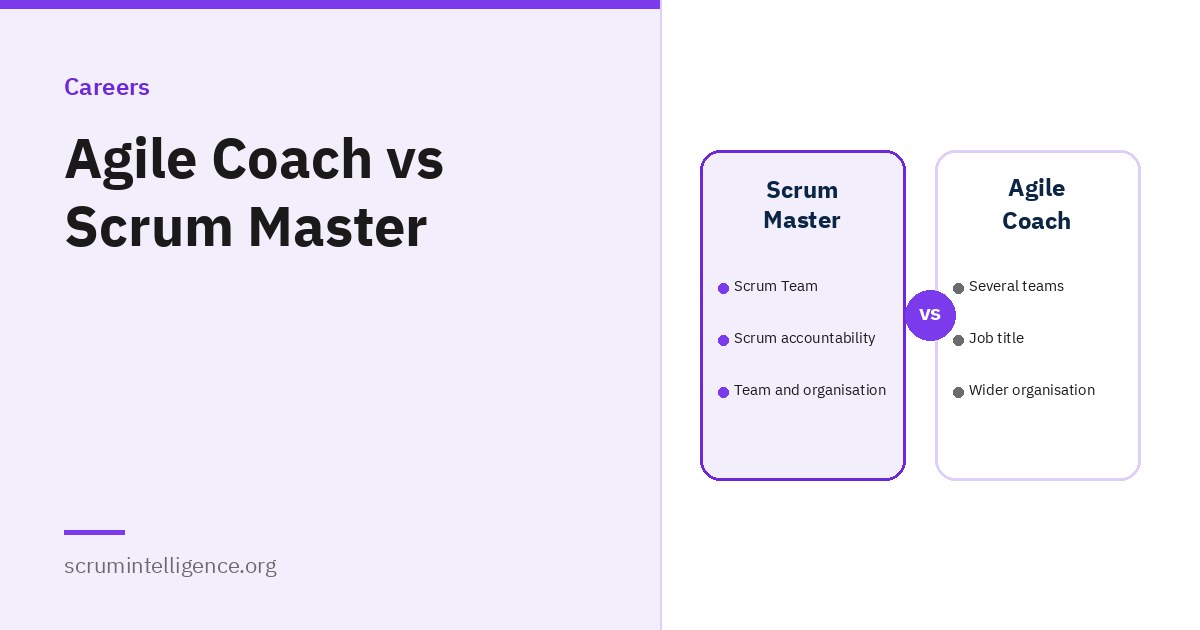
"Scrum Master" and "Agile Coach" are often used interchangeably, and many job adverts blur the two. They overlap a great deal, but they are not the same. The Scrum Master is an accountability defined in the Scrum Guide. Agile Coach is a job title with no single official definition, usually describing someone who helps teams and organisations adopt agile ways of working more broadly. This guide explains the differences, where the roles overlap and how to move from one to the other.
Key takeaways
- The Scrum Master is one of three accountabilities in the Scrum Guide; Agile Coach is not defined in the Scrum Guide.
- Scrum Masters focus on Scrum and the effectiveness of a Scrum Team; Agile Coaches often work across several teams and approaches.
- Both roles coach, teach, mentor and facilitate.
- Many Agile Coaches were previously Scrum Masters.
- What each role means varies by organisation, so always check the job description.
The quick answer
A Scrum Master is accountable for establishing Scrum and for the Scrum Team's effectiveness, and serves the team, the Product Owner and the organisation. An Agile Coach typically helps teams, leaders and organisations adopt and improve agile ways of working, often across several teams and using a range of approaches, not only Scrum. In many organisations, an experienced Scrum Master already does a great deal of agile coaching.
What is a Scrum Master?
According to the Scrum Guide, the Scrum Master is accountable for establishing Scrum as defined in the guide and for the Scrum Team's effectiveness. The Scrum Guide describes Scrum Masters as true leaders who serve the Scrum Team and the larger organisation. Their responsibilities include coaching team members in self-management, helping the Product Owner with backlog techniques, causing the removal of impediments, and leading, training and coaching the organisation in its Scrum adoption. See our complete Scrum Master guide and what does a Scrum Master do?
What is an Agile Coach?
The Scrum Guide does not define an Agile Coach, and neither does any single official body. In practice, Agile Coaches commonly:
- Coach several teams, often including their Scrum Masters and Product Owners
- Coach leaders and managers on agile leadership
- Help organisations plan and run agile transformations
- Work with several approaches, such as Scrum, Kanban and Lean practices
- Design and deliver training and workshops
- Help improve structures, processes and culture across an organisation
Some organisations distinguish team-level coaches, who work closely with a few teams, from enterprise coaches, who work with leadership and organisational change.
Scrum Master vs Agile Coach: side by side
This comparison describes common patterns. Individual organisations vary a lot.
| Scrum Master | Agile Coach (typical) | |
|---|---|---|
| Defined by | The Scrum Guide | Each organisation |
| Main focus | Scrum and the Scrum Team's effectiveness | Agile ways of working across teams and the organisation |
| Scope | Usually one or a few Scrum Teams, plus the organisation around them | Often several teams, leaders or a whole organisation |
| Approaches | Scrum | Scrum, Kanban, Lean and others |
| Works with | Developers, Product Owner, stakeholders | Teams, Scrum Masters, Product Owners, managers, executives |
| Part of the team? | Yes, a member of the Scrum Team | Often external to teams |
| Typical experience | From new to very experienced | Usually several years of agile experience |
Where the roles overlap
Both roles move between the same ways of helping. Lyssa Adkins, in her 2010 book Coaching Agile Teams, described the different stances an agile coach takes, such as teacher, mentor, coach, facilitator and problem solver. Experienced Scrum Masters use the same stances every day.
Lyssa Adkins and Michael Spayd later described the Agile Coaching Competency Framework, which groups the skills of agile coaching into areas such as teaching, mentoring, professional coaching, facilitating, and mastery in technical, business and transformation topics. It is a useful map of skills for Scrum Masters and Agile Coaches alike.
The key differences explained
Accountability versus job title
The Scrum Master has a defined accountability within a Scrum Team. An Agile Coach's responsibilities are set by the organisation that employs them, so they vary widely.
Scope
A Scrum Master works with a Scrum Team and helps the wider organisation work with Scrum. An Agile Coach's scope is often broader: several teams, groups of Scrum Masters, or organisation-wide change.
Framework focus
A Scrum Master's expertise is centred on Scrum. An Agile Coach typically draws on several approaches and helps choose what fits each context.
Relationship to teams
A Scrum Master is a member of the Scrum Team. An Agile Coach is usually outside the teams they coach, which can give a helpful outside perspective.
Can one person be both?
Yes. Many Scrum Masters act as agile coaches for their teams and parts of their organisation, and some organisations use the titles interchangeably. The Scrum Guide describes the Scrum Master's responsibilities to the organisation, including leading, training and coaching Scrum adoption, which is agile coaching work. The main limit is time: a Scrum Master working closely with a team may not have capacity for organisation-wide coaching as well.
Does an organisation need both?
A small organisation with one or two Scrum Teams usually needs Scrum Masters, and experienced Scrum Masters can cover much of the coaching. Larger organisations going through significant change often benefit from Agile Coaches who support several teams and leadership, alongside Scrum Masters in each team. What matters is that someone is clearly responsible for team effectiveness and someone supports organisation-wide improvement.
A day in each role, as an example
A Scrum Master's day
- Observing the Daily Scrum and following up on an impediment
- Helping the Product Owner prepare a refinement session
- Coaching a Developer who is new to the team
- Working with another team's Scrum Master on a dependency
An Agile Coach's day
- A coaching session with a group of Scrum Masters
- A workshop with managers on delegating decisions
- Observing two teams' Sprint Reviews and giving feedback to their coaches
- Meeting leadership about the next step in the organisation's transformation
Coaching stances in practice
As an illustration, imagine a team whose Daily Scrum regularly runs to 30 minutes. A Scrum Master or Agile Coach might respond in different ways depending on what the team needs:
- As a teacher: explaining the purpose of the Daily Scrum and its 15-minute timebox.
- As a facilitator: helping the team hold a short discussion about how it wants to run the event.
- As a coach: asking, "What do you notice about our Daily Scrum? What would make it more useful?" and letting the team find its own answer.
- As a mentor: sharing how other teams they have worked with solved the same problem.
Choosing the right stance for the moment is one of the core skills of both roles.
How organisations structure coaching
- Embedded coaches: an Agile Coach works closely with a small group of teams for an extended period.
- A coaching community: Scrum Masters and coaches across the organisation meet regularly to share practices and support each other, often as a community of practice.
- A central agile team: a small group of coaches supports transformation across the organisation, working with leadership.
- External coaches: brought in for a period to start or accelerate change, often while building internal coaching capability.
Signs an organisation may need an Agile Coach
- Several teams are adopting agile ways of working at once and need consistent support.
- Scrum Masters want coaching and development themselves.
- Leaders are unsure how their own role should change.
- Teams are stuck on problems that come from outside the team, such as structure or funding.
- The organisation is starting a significant transformation.
Questions to ask when hiring for either role
- How would you help a team that keeps missing its Sprint Goal?
- Describe a time you helped someone solve a problem without giving them the answer.
- How do you decide whether to teach, coach or facilitate?
- How would you handle a manager who overrules a team's decisions?
- How do you know your coaching is making a difference?
From Scrum Master to Agile Coach
Many Agile Coaches start as Scrum Masters. A common path is to gain deep experience with one team, then support several teams, then work with leaders and organisational change. Useful steps include learning Kanban and Lean practices, developing professional coaching skills, studying agile leadership and organisational change, and seeking opportunities to coach other Scrum Masters. Our guide on how to become an Agile Coach sets out the path in detail.
Coaching-specific credentials exist from several organisations. Examples include ICAgile's agile coaching certifications and professional coaching credentials from the International Coaching Federation (ICF). Credentials can help, but experience coaching real teams matters most to employers.
Common misconceptions
- "An Agile Coach is just a senior Scrum Master." Sometimes, but the scope and skills often differ, especially at organisation level.
- "Scrum Masters do not coach." Coaching is central to the Scrum Master accountability, according to the Scrum Guide.
- "An Agile Coach tells teams what to do." Good coaches help teams and leaders find their own answers, teaching or advising only when that is what is needed.
- "Once teams have a coach, leaders can step back." Coaches support change; leaders still need to lead it.
How the two roles work together
In organisations that have both, the relationship works best as a partnership. The Scrum Master stays close to the team and its daily work; the Agile Coach supports the Scrum Master's development, brings patterns from other teams, and helps address problems that sit outside any single team. Regular conversations between them, and a shared view of what each team needs, prevent duplicated effort and mixed messages to the team.
Agreeing how a coach works with a team
When an Agile Coach starts working with a team, it helps to agree the basics openly: what the team wants help with, how often the coach will join, whether the coach observes, facilitates or coaches individuals, and how the coach will share observations. Clear agreements prevent the team from feeling watched or judged, and make the coach's support far more effective.
Which role is right for you?
The Scrum Master role may suit you if you want to work closely with one team, see its progress every Sprint and become deeply skilled in Scrum. The Agile Coach role may suit you if you enjoy working across many teams, coaching leaders and shaping how an organisation works, and if you are comfortable with less day-to-day contact with delivery.
Build your skills
For experienced Scrum Masters moving towards coaching, Scrum Master Plus (Professional) focuses on coaching, facilitation and organisational change, and Scrum Leader Plus covers coaching multiple teams and cross-team dependencies. Both exams are taken online on ExamVault by CertExpert with three attempts included, and certificates and digital badges are valid for two years. See the certification pages for current learning paths and prices. For the leadership side, read our complete agile leadership guide.
Frequently asked questions
Is an Agile Coach the same as a Scrum Master?
No. The Scrum Master is an accountability in Scrum; Agile Coach is a job title that usually covers broader coaching across teams and approaches.
Is Agile Coach defined in the Scrum Guide?
No. The Scrum Guide defines three accountabilities: Scrum Master, Product Owner and Developers.
Can a Scrum Master become an Agile Coach?
Yes. It is one of the most common career paths for experienced Scrum Masters.
Which role is more senior?
Agile Coach roles often require more experience, but seniority depends on how each organisation defines the roles.
Does an Agile Coach only work with Scrum?
Usually not. Agile Coaches often work with Scrum, Kanban, Lean practices and other approaches.
Do small organisations need an Agile Coach?
Often not at first. Experienced Scrum Masters can cover much of the coaching a small organisation needs.
What skills does an Agile Coach need?
Teaching, mentoring, professional coaching and facilitation, plus deep knowledge of agile approaches, business and organisational change.
Are there certifications for Agile Coaches?
Yes. Examples include ICAgile's agile coaching certifications and professional coaching credentials from the International Coaching Federation.