
The Scrum Master is one of the three accountabilities in a Scrum Team, alongside the Product Owner and the Developers. It is also one of the most misunderstood roles in Agile work. A Scrum Master is not a team manager, not a project manager and not a meeting organiser. This guide explains what the role really involves, how Scrum works, the skills you need, the mistakes to avoid, and how to become a certified Scrum Master.
Key takeaways
- A Scrum Master is accountable for establishing Scrum and for the Scrum Team's effectiveness.
- The role serves three groups: the Scrum Team, the Product Owner and the wider organisation.
- Scrum Masters coach and facilitate. They do not assign tasks or manage people.
- Scrum has five events, three artifacts and three accountabilities, all defined in the Scrum Guide.
- You do not need a technical background, but you do need a solid understanding of Scrum and strong people skills.
What is a Scrum Master?
Scrum is a lightweight framework for delivering value in complex work, where requirements change and outcomes are hard to predict up front. Ken Schwaber and Jeff Sutherland first presented Scrum publicly in 1995. They published the first Scrum Guide in 2010 and have updated it several times since. The current edition was published in November 2020, and it is the document most Scrum training and exams are based on.
According to the Scrum Guide, the Scrum Master is accountable for establishing Scrum as the guide defines it, and for the Scrum Team's effectiveness. They do this by helping everyone, inside the team and across the organisation, understand Scrum theory and practice. The guide describes Scrum Masters as leaders who serve the Scrum Team and the wider organisation. That is why the role is often called servant leadership: the Scrum Master leads by removing obstacles and building the team's ability, not by giving orders.
In practice, a good Scrum Master works themselves toward being less needed. As a team becomes better at self-management, the Scrum Master spends less time on the basics and more time on harder problems, such as organisational impediments or collaboration with other teams.
What does a Scrum Master do?
The Scrum Guide describes the Scrum Master's work in three areas. We explain each in more depth in What does a Scrum Master do?
Serving the Scrum Team
- Coaching self-management and cross-functionality. Instead of deciding who takes which task, the Scrum Master helps the Developers organise their own work and build the range of skills they need as a team.
- Keeping the focus on Done. The Scrum Master helps the team create high-value Increments that meet the Definition of Done, rather than a lot of work that is almost finished.
- Causing the removal of impediments. The guide says "causing", not "removing". Sometimes the Scrum Master clears a blocker directly. More often, they help the team solve it, or raise it with the person who has the authority to fix it.
- Making the events work. The Scrum Master makes sure all Scrum events take place and are positive, productive and kept within their timebox. That does not mean leading every event. The Daily Scrum, for example, belongs to the Developers.
Serving the Product Owner
- Helping find techniques for defining the Product Goal and managing the Product Backlog
- Helping the Scrum Team understand why clear and concise Product Backlog items matter
- Helping establish empirical product planning, where plans are updated as the team learns
- Facilitating collaboration with stakeholders when it is requested or needed
Serving the organisation
- Leading, training and coaching the organisation in its Scrum adoption
- Planning and advising on Scrum implementations
- Helping employees and stakeholders understand and use an empirical approach to complex work
- Removing barriers between stakeholders and Scrum Teams
How Scrum works: the framework in brief
A Scrum Master cannot help a team use Scrum well without knowing the framework thoroughly. Here are the essentials.
Empiricism, pillars and values
Scrum is based on empiricism, the idea that knowledge comes from experience and decisions should be based on what is observed, and on lean thinking, which aims to reduce waste and focus on essentials. Scrum rests on three pillars: transparency (the work and progress are visible), inspection (progress is checked often) and adaptation (the team adjusts as soon as it finds a problem). Scrum also has five values: commitment, focus, openness, respect and courage.
The Scrum Team
A Scrum Team is small, typically ten or fewer people, with no sub-teams or hierarchies. It consists of one Scrum Master, one Product Owner and the Developers. The team is cross-functional, meaning it has all the skills needed to create value each Sprint, and self-managing, meaning it decides internally who does what, when and how.
The five Scrum events
| Event | Purpose | Maximum length (one-month Sprint) |
|---|---|---|
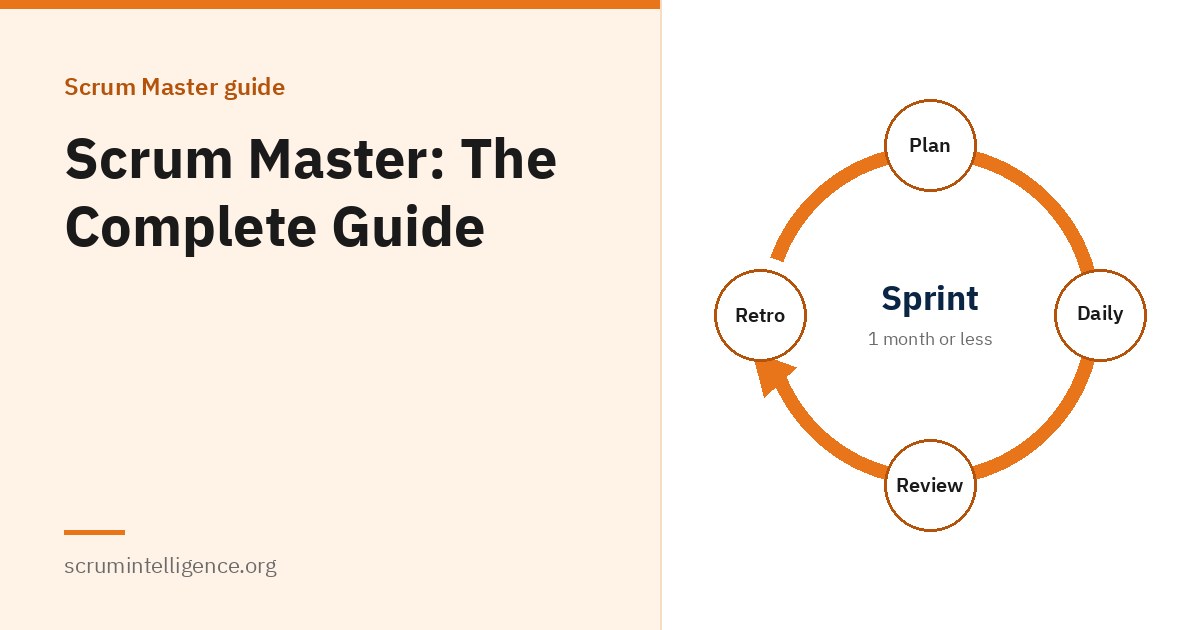
| Sprint | The container for all the other events, in which a usable Increment is created | One month or less |
| Sprint Planning | Agree why the Sprint is valuable, what can be Done and how | 8 hours |
| Daily Scrum | Developers inspect progress toward the Sprint Goal and adapt the plan | 15 minutes |
| Sprint Review | Inspect the outcome with stakeholders and decide what to do next | 4 hours |
| Sprint Retrospective | Plan ways to improve quality and effectiveness | 3 hours |
For shorter Sprints, Sprint Planning, the Sprint Review and the Retrospective are usually shorter. Read the five Scrum events explained for more detail on each one.
The three artifacts and their commitments
- Product Backlog: an ordered list of what is needed to improve the product. Its commitment is the Product Goal.
- Sprint Backlog: the Sprint Goal, the items selected for the Sprint and the plan for delivering them. Its commitment is the Sprint Goal.
- Increment: a usable step toward the Product Goal. Its commitment is the Definition of Done.
We explain each one in Scrum artifacts explained.
A Sprint in the life of a Scrum Master
The Scrum Guide describes accountabilities, not a daily schedule, so no two Scrum Masters work exactly the same way. Still, a typical Sprint often looks something like this:
- Start of the Sprint: the Scrum Master checks that the Product Backlog has been refined enough to plan with, and helps Sprint Planning end with a clear Sprint Goal and a realistic plan.
- Every day: they observe the Daily Scrum without taking it over, and listen for impediments, such as a dependency on another team or unclear requirements.
- During the Sprint: they follow up on impediments, coach individuals, support the Product Owner with backlog refinement, and help protect the Sprint Goal. Scope can be clarified and renegotiated with the Product Owner, but no changes should be made that endanger the Sprint Goal.
- Sprint Review: they help make it a genuine working session with stakeholders, rather than a one-way demo.
- Sprint Retrospective: they often facilitate, and make sure the agreed improvements are actually carried out. See how to run a Sprint Retrospective.
- Across the organisation: they work with managers and other teams to remove problems the team cannot solve alone.
Scrum Master vs project manager and Product Owner
Scrum Master vs project manager
The Scrum Guide defines only three accountabilities, and project manager is not one of them. A traditional project manager usually plans the work, assigns tasks and manages scope, schedule and budget. A Scrum Master does none of these directly. The Developers plan and manage their own work, and the Scrum Master focuses on the team's effectiveness and on removing what slows it down. Many organisations still employ project managers alongside Scrum Teams, especially for work that spans several teams. The full comparison is in Scrum Master vs project manager.
Scrum Master vs Product Owner
The Product Owner is accountable for maximising the value of the product and for managing the Product Backlog: deciding what to build and in what order. The Scrum Master is accountable for the team's effectiveness and for Scrum being understood and used well. The two work closely together, but their focus is different. One is about what the team builds, the other about how well the team works.
Skills every Scrum Master needs
- Facilitation: running events that keep to their purpose and timebox, and helping a group reach decisions everyone can commit to.
- Coaching: asking questions that help people find their own answers, rather than telling them what to do.
- Deep knowledge of Scrum: knowing the framework well enough to explain why each part exists, not just what it is.
- Handling conflict: helping team members work through disagreements openly and respectfully.
- Stakeholder communication: explaining how the team works to managers and customers who may be used to other approaches.
- Observation: noticing patterns, such as work that is always carried over or a team member who stops speaking up, and raising them at the right moment.
- Patience with change: helping an organisation adopt Scrum takes time, and progress is rarely a straight line.
Many Scrum Masters also learn related practices such as Kanban, which focuses on visualising work and managing flow. Kanban vs Scrum explains how the two compare.
Common mistakes Scrum Masters make
- Acting as the team's manager. Assigning tasks or approving work undermines self-management.
- Turning the Daily Scrum into a status report. It is for the Developers to plan their day, not for anyone to report upward.
- Skipping the Retrospective when things get busy. That is exactly when the team most needs to stop and improve.
- Accepting "nearly done" work. Without a clear Definition of Done, quality and transparency suffer.
- Solving every problem personally. A Scrum Master who removes every impediment alone stops the team from learning to handle them.
- Ignoring the organisation. Many of the biggest impediments sit outside the team, and the Scrum Master is accountable for helping address them too.
How to tell if a Scrum Master is effective
A Scrum Master's success is not measured by how many meetings they run or how busy they look. Because the role is accountable for the Scrum Team's effectiveness, the best evidence is in how the team works over time. Signs of an effective Scrum Master include:
- The Developers organise their own work and make decisions without waiting for instructions.
- Sprint Goals are clear, and the team meets them more often than not.
- Work regularly reaches the Definition of Done, instead of being carried over from Sprint to Sprint.
- Impediments are raised early and resolved faster than before.
- Retrospectives lead to real changes that the team can point to.
- Stakeholders take an active part in Sprint Reviews and understand how the team works.
None of these happen overnight. A useful habit is to agree with the team what "better" looks like, and to look back at it every few Sprints.
Scrum outside software
Scrum was first used in software development, and that is still where it is most common. But the framework is not limited to software. Teams in marketing, operations, research, education and other areas also use Scrum for complex work, where the best way forward becomes clear only by trying, inspecting and adapting. The Scrum Master's accountabilities stay the same whatever the team produces.
Tools Scrum Masters commonly use
Scrum does not require any particular tool. Many teams start with a physical board and sticky notes, and that is enough to make work visible. As teams grow or work remotely, they often use:
- A digital board or backlog tool to manage the Product Backlog and Sprint Backlog
- An online whiteboard for Sprint Planning, Reviews and Retrospectives
- A simple timer to help events stay within their timebox
- A shared place for the Definition of Done and team working agreements
The tool matters much less than how the team uses it. A Scrum Master's job is to make sure tools support transparency, not replace conversations.
How to become a Scrum Master
- Learn the Scrum Guide. It is short, free and the definitive description of Scrum. Read it more than once, and study why each part exists.
- Take structured training. A course helps you understand how Scrum works in real teams, not just in theory.
- Get certified. A certification shows employers that your Scrum knowledge has been assessed. Our Scrum Master exam study plan can help you prepare.
- Practise in a real team. Offer to facilitate a Retrospective or Daily Scrum in your current team, even before you hold a Scrum Master title.
- Learn from others. Local Agile groups and experienced Scrum Masters are a valuable source of practical advice.
- Keep learning. Experienced Scrum Masters often go on to support several teams, which needs a broader set of skills.
For a detailed plan, read How to start a career as a Scrum Master.
Getting certified as a Scrum Master
Several organisations offer Scrum Master certifications, and they differ in format, cost and exam style. If you are comparing well-known options from other certification bodies, our article comparing two popular Scrum certifications sets out the differences.
Scrum Intelligence offers its own online Scrum Master certification, Scrum Master Plus (Associate). It includes:
- 16 hours of training
- An online exam on ExamVault by CertExpert, with three attempts included in the fee
- A certificate and a digital badge that anyone can verify on LiveCertification
- A credential that is valid for two years
You can take it on its own or combine it with a partner certification in the same enrolment. Experienced Scrum Masters can go further with Scrum Master Plus (Professional), which focuses on coaching, facilitation and leading organisational change.
Scrum Master career path
A typical path starts with a Scrum Master role for a single team. With experience, many Scrum Masters go on to support several teams, become Agile Coaches, or move into roles that lead Agile adoption across an organisation. Scrum Leader Plus is designed for that next step, covering coaching multiple teams, cross-team dependencies and organisational change.
Pay varies widely by country, industry and experience. Our Scrum Master salary guide looks at what affects earnings.
The Scrum Master role and AI
For practical examples, see how Scrum Masters can use AI.
AI tools are starting to help with parts of the job, such as summarising discussions, spotting recurring impediments or preparing data for a Retrospective. They do not replace the judgement, trust and facilitation the role depends on. A tool can summarise what was said; it cannot sense that someone in the room is holding back. Scrum Master AI Plus covers how to use these tools in everyday Scrum work.
Frequently asked questions
Do I need a technical background to become a Scrum Master?
No. Scrum is used well beyond software, and the role depends more on facilitation, coaching and a solid understanding of Scrum than on technical skills. Some familiarity with how your team's work is done does help you understand their impediments.
Is Agile the same as Scrum?
No. Agile is a set of values and principles described in the Agile Manifesto. Scrum is one framework for putting those ideas into practice. Agile vs Scrum explains the difference in detail.
Is a Scrum Master a manager?
No. A Scrum Master does not assign tasks or manage people's performance. The Scrum Guide describes the role as a leader who serves the team and the organisation, by coaching, facilitating and helping remove impediments.
Can a Scrum Master also be a Developer?
Yes, it is possible. The Scrum Guide notes that if the Scrum Master or Product Owner is actively working on items in the Sprint Backlog, they take part in the Daily Scrum as Developers. Combining the roles takes care, because it is easy for one to crowd out the other.
How many teams can one Scrum Master support?
The Scrum Guide does not set a number. It depends on how experienced the teams are and how much support they need. A new team usually needs more of a Scrum Master's time than a mature one.
What is the difference between a Scrum Master and a Product Owner?
The Product Owner decides what the team builds and orders the Product Backlog to maximise value. The Scrum Master helps the team work effectively and use Scrum well. Both are accountabilities within the same Scrum Team.
How long does it take to become a Scrum Master?
It varies. You can learn the Scrum Guide and complete a certification in a few weeks: Scrum Master Plus (Associate), for example, includes 16 hours of training. Becoming confident in the role takes longer, because it depends on real experience with a team.
How long is the Scrum Master Plus certification valid?
Two years. The exam is taken online on ExamVault by CertExpert, and three attempts are included in the fee.