
Most OKRs fail not at the writing stage but afterwards, when they are set at the start of a quarter and forgotten until the end. Regular check-ins and honest reviews are what turn OKRs from a planning document into a tool for focus and learning. This guide explains how to run weekly check-ins, mid-quarter reviews and end-of-quarter scoring and reflection, with agendas, templates and tips for handling key results that are off track.
Key takeaways
- Short, regular check-ins, often weekly, keep OKRs alive and surface problems early.
- Confidence scores show how likely the team thinks it is to reach each key result.
- A mid-quarter review is the moment to adjust initiatives, or even key results, if circumstances have changed.
- End-of-quarter scoring is for learning, not for ranking people.
- A short reflection at the end of each cycle improves the next set of OKRs.
The OKR rhythm
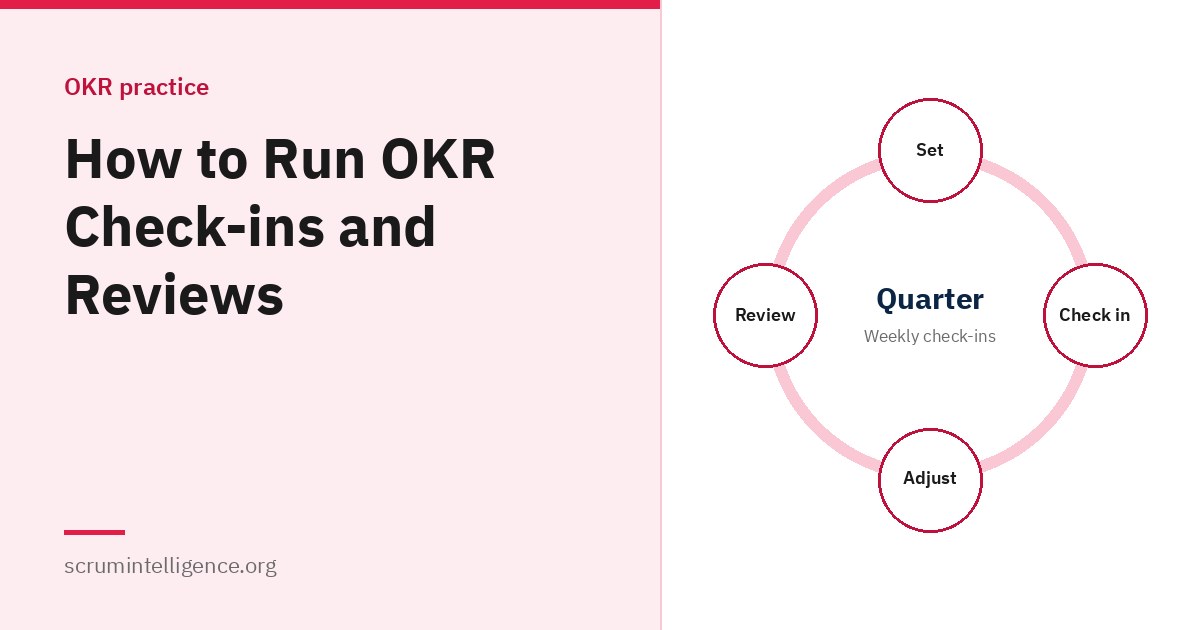
A typical rhythm for a quarterly OKR cycle:
| When | What | Purpose |
|---|---|---|
| Start of quarter | Set and align OKRs | Agree focus |
| Every week | Short check-in | Track progress and agree priorities |
| Mid-quarter | Review | Adjust initiatives or OKRs if needed |
| End of quarter | Score and reflect | Learn and prepare the next cycle |
For the full picture, see our complete OKR guide.
Weekly check-ins
A weekly check-in is short, often 15 to 30 minutes. Its purpose is to look at progress on each key result, agree what matters most this week and raise problems early.
A simple agenda
- Progress: the latest value for each key result.
- Confidence: each owner gives a confidence score for reaching the key result by the end of the quarter.
- Priorities: the most important things to do this week to move the key results.
- Risks and help needed: anything blocking progress, and who can help.
Confidence scores
Christina Wodtke, in her 2016 book Radical Focus, describes asking for a confidence score, for example on a scale of 1 to 10, for each key result each week. The number itself matters less than how it changes. A key result whose confidence drops from 7 to 4 deserves discussion, even if the measure itself has not moved yet.
The four-square format
Wodtke also describes a simple one-page format with four areas:
- This week's priorities: the few things that matter most right now
- The next few weeks: what is coming up that the team should prepare for
- OKR status: each key result with its confidence score
- Health measures: things that must not suffer, such as team health or customer satisfaction
Monday commitments and Friday wins
In the same book, Wodtke suggests a weekly rhythm: a Monday meeting to agree priorities and review confidence, and a Friday session to celebrate what the team achieved. The Friday habit helps teams notice progress and stay motivated through ambitious goals.
The mid-quarter review
Halfway through the quarter, take a slightly longer look, perhaps an hour:
- Which key results are on track, and which are not?
- Are our initiatives actually moving the key results?
- Has anything changed in the organisation or market that makes an OKR less relevant?
- Do we need help from other teams or leaders?
It is usually better to change initiatives than key results. But if circumstances have changed significantly, update or drop an OKR openly and explain why. Pretending an outdated OKR still matters wastes effort and undermines trust in the process.
Handling key results that are off track
- Understand why: is the initiative not working, was the target unrealistic, or has something outside the team changed?
- Try a different approach: change the initiative before changing the goal.
- Ask for help: raise dependencies or blockers with the people who can resolve them.
- Refocus: sometimes it is better to concentrate on the key results with most potential.
- Record the learning: an off-track key result often teaches something valuable for the next cycle.
End-of-quarter scoring
Scoring methods
- 0.0 to 1.0 scale: commonly used, including at Google. For example, a key result to increase a measure from 50 to 70 that reaches 65 scores 0.75.
- Traffic lights: green for achieved or nearly achieved, amber for partial progress, red for little progress. Simple and easy to read.
- Percentage achieved: straightforward for metric-based key results.
Interpreting scores
For committed OKRs, the expectation is full achievement. For aspirational OKRs, Google has described scores of around 0.6 to 0.7 as a good result. Consistently scoring 1.0 on aspirational OKRs may mean the goals were not ambitious enough; consistently scoring very low may mean they were unrealistic or the team lacked focus.
Score for learning, not judgement
Scores should prompt questions, not blame. Many practitioners advise keeping OKR scores separate from individual performance ratings and bonuses, so that teams stay ambitious and honest.
The end-of-quarter reflection
A short reflection, much like a Scrum Retrospective, improves the next cycle. Useful questions:
- Which key results did we achieve, and what made the difference?
- Which did we miss, and what did we learn?
- Were our key results the right measures of our objectives?
- Did we have too many OKRs, or too few?
- How well did our check-ins work?
- What will we do differently next quarter?
See how to run a Sprint Retrospective for facilitation formats that work well here too.
Check-ins for Scrum Teams
Scrum Teams already have regular inspection events. Rather than adding separate meetings, many teams look at key results during the Sprint Review with stakeholders, and discuss how the team works toward them in the Retrospective. The Daily Scrum remains focused on the Sprint Goal. See OKRs and Scrum.
Remote check-ins
- Keep a single shared page with every key result, its current value and confidence score.
- Ask owners to update figures before the meeting, so time is spent on discussion.
- Use rounds so everyone gives a confidence score.
- Record decisions and help needed in the same place.
Tools
A shared document or spreadsheet is enough for most teams. Dedicated OKR tools can help larger organisations see alignment and progress across many teams, but they do not replace the conversation. Start simple, and add tools only when your rhythm is working.
A worked example: a quarter of check-ins
As an illustration, a team has the objective "Help customers solve problems themselves", with key results to increase help-article answers from 30% to 50% and reduce repeat contacts by 40%.
- Week 1: confidence is 7 and 6. The team prioritises finding the most common questions.
- Week 3: the team publishes ten articles. Help-article answers rise to 34%, but confidence in the second key result falls to 4, because repeat contacts are mostly about billing, which the articles do not cover.
- Week 6, mid-quarter review: the team agrees with the billing team to fix the top two billing problems, and focuses its own articles on billing questions.
- Week 9: repeat contacts are down 25%; confidence rises to 6.
- Week 13, scoring: the key results score 0.8 and 0.7. In the reflection, the team notes that checking the reasons behind repeat contacts earlier would have saved several weeks.
The weekly confidence scores made the problem visible early; the mid-quarter review turned it into action.
Facilitating check-ins well
- Keep to time: short, predictable meetings are easier to sustain.
- Focus on change: what moved, what did not and why, rather than reading out every figure.
- Make it safe to report bad news: thank people for raising falling confidence early.
- End with priorities: everyone should leave knowing what matters most this week.
- Rotate facilitation: it spreads ownership across the team.
Check-ins across teams
When several teams share objectives or depend on each other, a short cross-team check-in, perhaps every two weeks, helps. Representatives share key result progress, confidence and dependencies. It is often where blocked work between teams is spotted and resolved.
A sample end-of-quarter summary
A one-page summary helps leaders and other teams learn from each cycle. It usually includes:
- Each objective and key result, with final score
- Two or three things that made the biggest difference
- Two or three things the team learned
- What the team will do differently next quarter
- Any help needed from leaders or other teams
Using data to prepare check-ins
Check-ins go faster when key result figures are updated before the meeting, ideally automatically from the source systems. Where that is not possible, ask each key result owner to update the shared page the day before. Time in the meeting is then spent on what the numbers mean and what to do next, rather than on finding them.
Check-ins for leadership teams
Leadership teams benefit from the same discipline. A short fortnightly or monthly check-in on organisational OKRs, with confidence scores and requests for help from teams, keeps leaders connected to progress and shows teams that leaders take OKRs seriously. It is also where leaders can remove organisational obstacles that teams have raised.
When a key result is achieved early
Sometimes a key result is reached well before the end of the quarter. Celebrate it, then decide what to do with the freed-up capacity: push further if the extra improvement is valuable, shift focus to other key results, or pull forward something from the next cycle. Note in the end-of-quarter reflection whether the target was set too low, so the next one is better calibrated.
Common mistakes
- No check-ins: OKRs are only reviewed at the end of the quarter.
- Status theatre: check-ins become long status reports rather than conversations about priorities and problems.
- Hiding bad news: confidence scores are always high until the last week.
- Changing key results too easily: goals are adjusted whenever they become hard.
- Never changing anything: outdated OKRs are kept even when circumstances have changed.
- Scoring to judge people: this encourages safe goals and inflated reporting.
Learn more
For writing better OKRs, see how to write good OKRs, and for the difference from ongoing measures, OKRs vs KPIs. Scrum Agile OKR Plus covers using OKRs with agile teams; it includes self-paced training and an online exam on ExamVault by CertExpert with three attempts included, and the certificate and digital badge are valid for two years.
Frequently asked questions
How often should OKRs be reviewed?
Many teams check in weekly, hold a longer review mid-quarter and score and reflect at the end of the quarter.
How long should an OKR check-in take?
Usually 15 to 30 minutes for a team.
What is a confidence score?
A regular estimate, for example from 1 to 10, of how likely the team is to reach a key result by the end of the period.
How are OKRs scored?
Commonly on a 0.0 to 1.0 scale, or with traffic lights. For aspirational OKRs, around 0.6 to 0.7 is often considered a good result.
Can OKRs be changed during the quarter?
Yes, if circumstances change significantly. It is usually better to change initiatives first, and to change OKRs openly with an explanation.
What is the four-square format?
A one-page check-in format described by Christina Wodtke, covering this week's priorities, the next few weeks, OKR status and health measures.
Should OKR scores affect performance reviews?
Many practitioners advise against linking scores directly to individual ratings or bonuses.
Do Scrum Teams need separate OKR check-ins?
Often not. Key results can be reviewed at the Sprint Review and discussed in the Retrospective.