
OKRs, short for Objectives and Key Results, are one of the most widely used ways for organisations and teams to set goals. They are simple to describe: an objective says what you want to achieve, and a few key results show how you will know you achieved it. They are much harder to use well. This guide explains where OKRs come from, how they work, how to write and track them, how they fit with agile ways of working, and the mistakes to avoid.
Key takeaways
- An objective is a clear, meaningful goal; key results are a small number of measurable outcomes that show progress toward it.
- OKRs were developed by Andy Grove at Intel and popularised by John Doerr, who introduced them to Google in 1999.
- Good key results measure outcomes, not tasks or activity.
- OKRs work best with a few focused objectives, regular check-ins and honest scoring.
- Many practitioners advise keeping OKRs separate from pay and bonuses, so people set ambitious goals and report progress honestly.
What are OKRs?
OKRs are a goal-setting framework with two parts:
- Objective: what you want to achieve. It is qualitative, clear and meaningful, and should inspire the people working toward it.
- Key results: how you will know you have achieved it. Each key result is specific and measurable, usually with a number and a deadline.
John Doerr summarises the idea with a simple formula: "I will [objective] as measured by [key results]." For example:
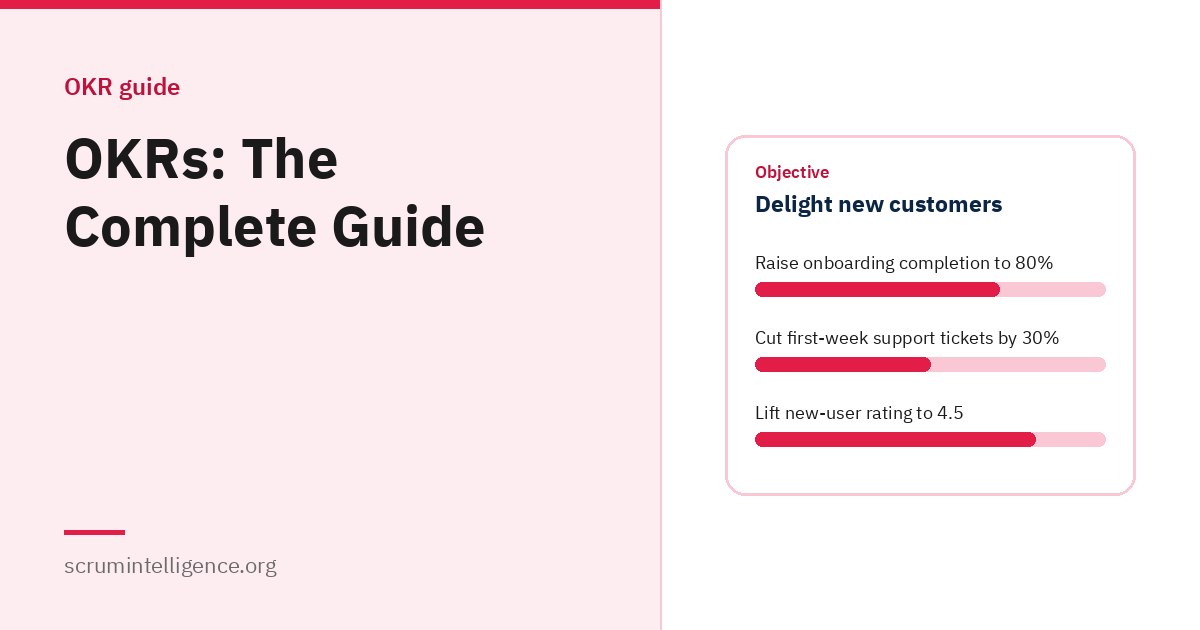
Objective: Make onboarding effortless for new customers.
- Key result 1: Increase the share of new customers who complete onboarding from 55% to 80%.
- Key result 2: Reduce support tickets from customers in their first week by 30%.
- Key result 3: Raise the average rating new customers give onboarding from 3.8 to 4.5.
The objective gives direction and meaning; the key results make progress visible and remove ambiguity about what "effortless" means.
Where OKRs come from
Management by Objectives
OKRs build on Management by Objectives (MBO), an approach described by Peter Drucker in his 1954 book The Practice of Management. MBO emphasised agreeing clear objectives between managers and employees.
Andy Grove and Intel
In the 1970s, Andy Grove, who later became Intel's CEO, adapted these ideas into the system that became OKRs. He added measurable key results, shorter cycles and a focus on a few priorities. Grove described the approach in his 1983 book High Output Management.
John Doerr and Google
John Doerr learned OKRs while working at Intel. As an investor, he introduced them to Google's founders in 1999, when the company was still small. Google used OKRs as it grew, which helped make them widely known. Doerr later described OKRs, with examples from many organisations, in his 2018 book Measure What Matters.
Writing good objectives
A good objective:
- Is qualitative and clear: anyone can understand what it means.
- Is meaningful: it explains why the work matters.
- Is ambitious but achievable within the time period.
- Is within the team's influence: the team can make real progress on it.
- Is not a task: "Launch the new app" is a task; "Give customers a faster way to manage their accounts" is an objective.
Writing good key results
For a step-by-step method and many examples, see how to write good OKRs.
Good key results are specific, measurable and focused on outcomes. They answer the question: "How will we know we have achieved the objective?"
Outcomes, not output
| Output (weak key result) | Outcome (stronger key result) |
|---|---|
| Launch the new onboarding flow | Increase onboarding completion from 55% to 80% |
| Publish 20 help articles | Reduce "how do I" support tickets by 25% |
| Hold 10 customer interviews | Identify and validate the top three reasons customers cancel |
| Hire two engineers | Reduce average time to fix critical bugs from 5 days to 2 |
Output can be useful to track, but it belongs in the plan of work, not in the key results. The work that is expected to move a key result is often called an initiative.
Leading and lagging measures
Lagging measures, such as revenue or customer retention, show results after the fact. Leading measures, such as onboarding completion or weekly active use, move sooner and help teams adjust within the quarter. Many teams include at least one leading measure among their key results.
How many?
Common guidance is a small number of objectives, often three to five at most, each with around three to five key results. Christina Wodtke, in her 2016 book Radical Focus, goes further, recommending that a team focus on a single objective at a time. The underlying principle is the same: OKRs are about focus, and too many dilute it.
Committed and aspirational OKRs
Google distinguishes two kinds of OKRs:
- Committed OKRs: goals the team agrees it will achieve. Full delivery is expected.
- Aspirational OKRs: stretch goals that describe how the world could look if everything went well. Teams are not expected to achieve them fully.
Being clear which type each OKR is prevents confusion. A team that achieves 70% of an aspirational key result may have done excellent work; a team that achieves 70% of a committed one has fallen short.
Scoring OKRs
Many organisations score key results at the end of the period on a scale from 0.0 to 1.0, where 1.0 means fully achieved. Google has described a score of around 0.6 to 0.7 as a good result for aspirational OKRs; consistently scoring 1.0 may mean the goals were not ambitious enough. Scoring is most useful as a basis for learning: why did we fall short, or why was it easier than expected? It should not become a way of ranking people.
The OKR cycle
For agendas and templates, see how to run OKR check-ins and reviews.
- Set: at the start of the period, often a quarter, agree a few objectives and key results.
- Align: check that team OKRs support organisational priorities, and that teams depending on each other know about each other's OKRs.
- Check in: review progress regularly, often weekly, and decide what to focus on next.
- Adjust: if circumstances change significantly, update or drop OKRs openly rather than pretending.
- Score and reflect: at the end of the period, score the key results and discuss what was learned.
- Repeat: use what was learned to set the next OKRs.
Wodtke's Radical Focus describes a simple weekly rhythm: a Monday meeting to review confidence in the key results and agree priorities, and a Friday celebration of progress.
Aligning OKRs across an organisation
OKRs help connect the work of many teams to a shared direction. Alignment works best when it flows both ways:
- Top-down: leaders set a few organisational objectives that express strategy.
- Bottom-up: teams propose OKRs that show how they can contribute, based on their knowledge of customers and the work.
- Across: teams that depend on each other share their OKRs early, so dependencies are visible.
Doerr and others caution against cascading every objective rigidly down the organisation, which can turn OKRs into a slow, bureaucratic exercise and remove teams' ownership.
Conversations, feedback and recognition
In Measure What Matters, Doerr pairs OKRs with CFRs: conversations, feedback and recognition. The idea is that goal-setting works best alongside regular, honest conversations between managers and team members, continuous feedback and recognition of contributions. OKRs without these conversations tend to become a reporting exercise.
OKRs and pay
Many practitioners, including Doerr, advise keeping OKRs separate from compensation. If bonuses depend on scoring 1.0, people naturally set safe goals and report progress optimistically, which defeats the purpose of ambitious, honest goal-setting. Performance conversations can still consider how people contributed, but not as a mechanical link to OKR scores.
OKR examples
For product-specific examples, see OKRs for product teams.
These examples are illustrations. Real OKRs should reflect your own context and data.
Company level
Objective: Become the easiest provider in our market to do business with.
- Increase customer satisfaction score from 72 to 80
- Reduce average time to resolve customer issues from 3 days to 1
- Increase the share of customers who renew from 85% to 90%
Product team
Objective: Make checkout effortless.
- Raise checkout completion from 58% to 70%
- Reduce average checkout time from 2 minutes to 1
- Halve payment errors
Customer support
Objective: Help customers solve problems themselves.
- Increase the share of questions answered by help articles from 30% to 50%
- Reduce repeat contacts about the same issue by 40%
People and HR
Objective: Help new joiners become productive quickly.
- Raise new-joiner onboarding satisfaction from 3.6 to 4.4 out of 5
- Reduce time until new engineers make their first contribution from 4 weeks to 2
OKRs in agile organisations
For a detailed guide, see OKRs and Scrum: how they work together.
OKRs and agile frameworks fit well together, because both focus on outcomes and learning in short cycles. In Scrum, a Product Goal describes the long-term objective for a product, and each Sprint has a Sprint Goal. OKRs can connect organisational strategy to Product Goals, with key results showing whether the product is moving in the right direction, while Sprint Goals describe the steps the Scrum Team takes each Sprint. OKRs do not replace any part of Scrum; they add a way to align many teams with strategy. See Product Goal and Sprint Goal explained and our complete Product Owner guide.
Flow data, such as cycle time and throughput, can also make good key results for teams improving how they deliver. See Kanban metrics explained.
Annual and quarterly OKRs
Many organisations use two horizons. Annual objectives express the bigger direction for the year, while quarterly OKRs set the specific key results teams focus on now. Quarterly cycles are short enough to learn and adjust, and long enough to achieve meaningful change. Some teams working in fast-changing environments use even shorter cycles; others find quarterly the right balance.
Who sets OKRs, and how long it takes
Leaders usually set a small number of organisational objectives. Teams then draft their own OKRs showing how they will contribute, and discuss them with leaders and with teams they depend on. The first time, this can take a few weeks. With practice, many organisations complete the process in a week or two around the start of each quarter. Keep it light: the goal is focus and alignment, not a perfect document.
A simple check-in template
Weekly check-ins keep OKRs alive. A short template many teams use:
| Key result | Current value | Confidence (1 to 10) | What changed this week | Focus for next week |
|---|---|---|---|---|
| Onboarding completion 55% to 80% | 63% | 6 | New welcome screen released | Fix drop-off at the payment step |
| First-week tickets down 30% | Down 12% | 5 | Two help articles published | Review top ticket reasons |
The confidence score, an idea Christina Wodtke describes in Radical Focus, shows how likely the team thinks it is to reach each key result. Falling confidence is an early warning worth discussing.
A worked example: one quarter
As an illustration, a product team sets the objective "Make onboarding effortless for new customers" with three key results.
- Weeks 1 to 3: the team studies where customers drop out and discovers most leave at the payment details step.
- Weeks 4 to 7: it simplifies that step and releases the change to half of new customers to compare results. Completion rises, and confidence in the first key result grows.
- Weeks 8 to 10: support tickets have fallen less than hoped. Check-ins reveal many tickets are about invoices, not onboarding, so the team adjusts its focus.
- Weeks 11 to 13: the team scores the key results: 0.8, 0.5 and 0.7. In the review, it learns that its ticket measure mixed two different problems, and writes a sharper key result for next quarter.
OKRs and KPIs in brief
For a full comparison, see OKRs vs KPIs.
Key performance indicators (KPIs) track the ongoing health of a business or process, such as revenue, uptime or customer satisfaction. OKRs focus on the few changes you want to make in a period. A useful rule of thumb: KPIs tell you whether things are healthy; OKRs describe what you are trying to improve. A KPI that needs significant improvement can become the basis for an OKR.
Tools for managing OKRs
A shared document or spreadsheet is enough to start and keeps attention on the conversation rather than the tool. Dedicated OKR software can help larger organisations with alignment and tracking, but it cannot make OKRs meaningful on its own. Choose tools only once your process is working.
Individual OKRs
Some organisations, including Google as described by Doerr, have used OKRs for individuals as well as teams. Many practitioners now recommend focusing on team OKRs, because most meaningful outcomes depend on people working together, and individual OKRs can multiply paperwork and encourage people to optimise their own goals instead of the team's. Individuals can still use personal development goals alongside team OKRs.
OKRs in startups and small companies
Small organisations often benefit most from OKRs, because focus is critical when resources are limited. Keep it very simple: one to three company objectives, a handful of key results, a weekly check-in and a short review each quarter. As the company grows, teams can add their own OKRs that support the company's objectives.
OKRs in the public sector and non-profits
OKRs are not only for technology companies. Public services and non-profits use them to focus limited resources on the outcomes that matter most to the people they serve, such as reducing waiting times, increasing take-up of a service or improving outcomes for a community. The same principles apply: a few meaningful objectives, measurable outcomes and regular review. Key results often focus on service quality and impact rather than revenue.
Introducing OKRs to sceptical teams
People who have experienced goal-setting as top-down target-setting may be wary of OKRs. It helps to start with a pilot, involve teams in writing their own OKRs, keep OKRs separate from pay, and show that falling short of an ambitious key result leads to learning, not blame. When teams see OKRs helping them focus and say no to less important work, scepticism usually fades.
Common OKR mistakes
For a detailed guide, see common OKR mistakes and how to avoid them.
- Too many OKRs: focus is lost.
- Tasks as key results: "launch X" measures activity, not results.
- Set and forget: OKRs written at the start of the quarter and not looked at again until the end.
- Everything cascaded from the top: teams lose ownership and speed.
- Linked to bonuses: encourages safe goals and inflated reporting.
- Vague key results: "improve customer experience" cannot be measured.
- Using OKRs for business-as-usual: routine health measures often belong in regular KPIs instead.
Getting started
- Start small: pilot OKRs with a few teams for one or two quarters.
- Keep it simple: one to three objectives per team, with a few key results each.
- Agree a rhythm: short weekly check-ins and a review at the end of the period.
- Keep tools light: a shared document or spreadsheet is enough to begin.
- Reflect and improve: treat the first cycles as learning, and adapt how you use OKRs.
Learn OKRs with Scrum Intelligence
Scrum Intelligence offers Scrum Agile OKR Plus, covering how to use OKRs with agile teams. It includes self-paced training and an online exam on ExamVault by CertExpert with three attempts included, and the certificate and digital badge are valid for two years. See the certification page for current learning paths and prices. For agile leadership, which shapes how OKRs are used, see our complete agile leadership guide.
Frequently asked questions
What does OKR stand for?
Objectives and Key Results.
Who invented OKRs?
Andy Grove developed OKRs at Intel in the 1970s, building on Peter Drucker's Management by Objectives. John Doerr later introduced them to Google and many other organisations.
What is the difference between an objective and a key result?
An objective is a qualitative goal describing what you want to achieve; key results are measurable outcomes that show whether you achieved it.
How many OKRs should a team have?
Usually only a few: often one to three objectives for a team, each with around three to five key results.
How often are OKRs set?
Many organisations set OKRs quarterly, with weekly check-ins and sometimes longer-term annual objectives.
How are OKRs scored?
Often on a 0.0 to 1.0 scale. For aspirational OKRs, around 0.6 to 0.7 is commonly treated as a good result.
Should OKRs be tied to bonuses?
Many practitioners advise against it, because it encourages safe goals and optimistic reporting.
Can OKRs be used with Scrum?
Yes. OKRs can connect strategy to Product Goals, while Sprint Goals describe each Sprint's step toward them.