
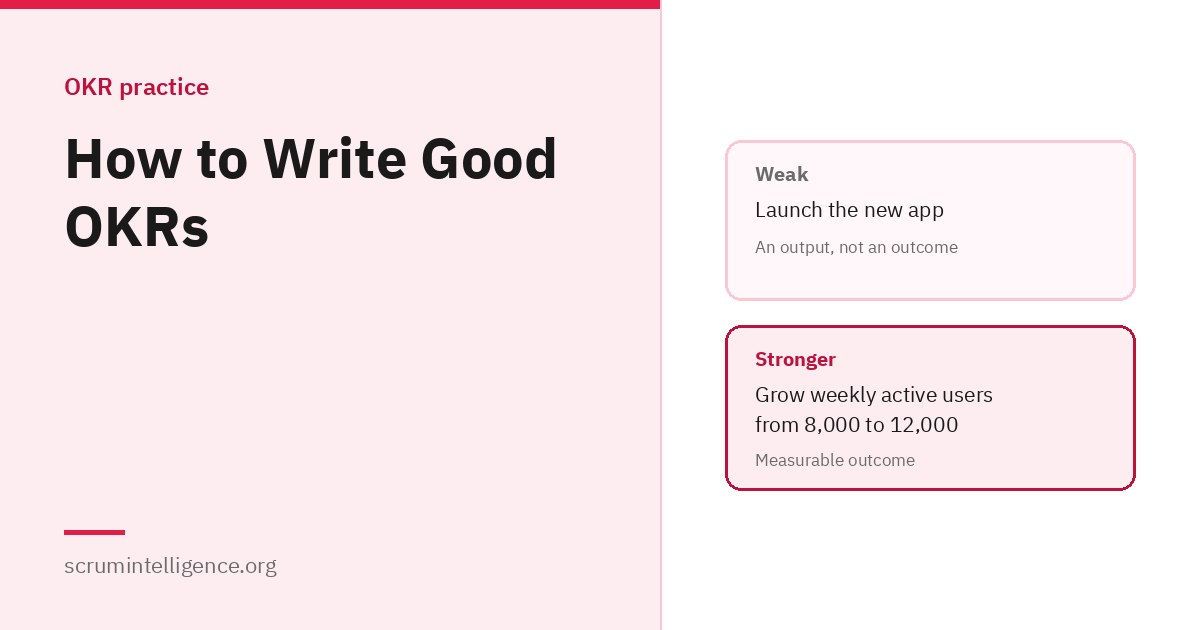
Most OKR problems start with the writing. Objectives that are really tasks, key results that measure activity instead of outcomes, and targets pulled from thin air all make OKRs feel like paperwork. Well-written OKRs, by contrast, give a team focus and make progress obvious. This guide shows you how to write good OKRs step by step, with checklists, a range of before-and-after examples and tips for setting targets.
Key takeaways
- Objectives should be clear, meaningful and qualitative; key results should be specific, measurable outcomes.
- Always ask "how would we know we achieved this?" to find good key results.
- Separate key results (outcomes) from initiatives (the work you plan to do).
- Set targets from a baseline; if you have no baseline, make establishing one part of the plan.
- Add counter-measures where a key result could be improved in harmful ways.
The anatomy of an OKR
An OKR has one objective and a small number of key results, usually around three to five. John Doerr's formula is a useful check: "I will [objective] as measured by [key results]." If the sentence reads naturally, the structure is probably right. For the basics and background, see our complete OKR guide.
Checklist for objectives
- Is it qualitative and easy to understand?
- Does it describe a meaningful change, not a task?
- Does it explain why the work matters?
- Can the team make real progress on it this period?
- Would the team feel motivated by it?
Checklist for key results
- Is it measurable, with a clear number?
- Does it have a starting point and a target?
- Does it measure an outcome, not an activity?
- Is it within the team's influence?
- Would achieving it clearly mean progress on the objective?
- Could it be achieved in a way that causes harm? If so, is there a counter-measure?
How to write OKRs, step by step
- Start with a problem or opportunity. What would make the biggest difference for customers or the organisation this period?
- Draft the objective. Describe the change you want in plain language.
- Ask "how would we know?" List signs that the objective has been achieved.
- Choose measures. Turn the strongest signs into measurable key results.
- Find the baseline. Where are you today on each measure?
- Set the target. Decide how far to move each measure, and whether the OKR is committed or aspirational.
- List initiatives separately. Note the work you expect to move the key results, but keep it out of the key results themselves.
- Review with others. Check alignment with organisational objectives and with teams you depend on.
Three kinds of key results
- Metric-based: "Increase X from A to B." The most common and usually the most useful.
- Threshold: "Keep X above or below a level," for example keeping uptime above an agreed level while making other changes.
- Milestone: "Complete X by a date." These are binary and closer to tasks, so use them sparingly, for example when a genuine one-off outcome matters.
Before-and-after examples
These examples are illustrations. Numbers should come from your own data.
Product team
- Weak: Objective "Build the new search." Key result "Release search by March."
- Stronger: Objective "Help customers find what they need quickly." Key results "Increase searches that lead to a purchase from 18% to 25%" and "Reduce 'no results' searches from 12% to 6%."
Engineering
- Weak: "Improve code quality."
- Stronger: Objective "Make releases boring and safe." Key results "Reduce production incidents caused by releases from 6 to 2 per quarter" and "Cut time to restore service from 3 hours to under 1."
Marketing
- Weak: "Publish 40 blog posts."
- Stronger: Objective "Become a trusted source for our customers' questions." Key results "Grow organic visits to guides from 20,000 to 30,000 a month" and "Increase newsletter sign-ups from guides from 1.5% to 3%."
Sales
- Weak: "Make more calls."
- Stronger: Objective "Win more of the right customers." Key results "Increase win rate on qualified opportunities from 20% to 28%" and "Reduce average sales cycle from 60 to 45 days."
Customer support
- Weak: "Answer tickets faster."
- Stronger: Objective "Resolve problems on first contact." Key results "Raise first-contact resolution from 65% to 80%" while "keeping customer satisfaction at or above 4.5."
People and HR
- Weak: "Run engagement survey."
- Stronger: Objective "Make this a place people want to stay." Key results "Reduce voluntary leavers in the first year from 18% to 12%" and "Raise the share of employees who would recommend us as an employer from 55% to 65%."
Operations
- Weak: "Improve delivery process."
- Stronger: Objective "Get orders to customers reliably." Key results "Increase on-time deliveries from 88% to 96%" and "Reduce damaged deliveries by half."
A Scrum Team
- Weak: "Increase velocity."
- Stronger: Objective "Deliver value to customers sooner." Key results "Reduce average cycle time from 9 days to 5" and "Release to customers every week instead of monthly." See Kanban metrics explained for flow measures.
Setting targets
Start from a baseline
A target only means something relative to where you are now. Look up the current value before setting a target, and note it in the key result: "from 55% to 80%".
When there is no baseline
If you cannot measure something yet, one sensible approach is to make establishing the baseline part of the plan early in the period, then set the target once data is available. Avoid guessing a number that the whole OKR then depends on.
How ambitious?
Decide whether each OKR is committed, meaning the team expects to achieve it fully, or aspirational, meaning a stretch goal where partial achievement is still success. Google has described around 0.6 to 0.7 as a good score for aspirational OKRs. Label each OKR so everyone reads the score correctly.
Counter-measures: protecting against harmful shortcuts
Some key results can be hit in ways that cause harm. Reducing support handling time could be achieved by rushing customers; increasing sign-ups could be achieved by misleading adverts. Adding a counter-measure, sometimes called a guardrail or health metric, keeps the team honest. For example: "Reduce average handling time from 8 to 6 minutes, while keeping customer satisfaction at or above 4.5."
Key results versus initiatives
Initiatives are the projects and tasks you believe will move your key results. Keeping them separate matters, because it lets the team change its plan when an initiative is not working, without changing the goal. For a Scrum Team, initiatives often become items in the Product Backlog, ordered by the Product Owner. See how to manage a Product Backlog.
Running an OKR writing workshop
- Share context (15 minutes): organisational objectives, customer insights and last period's results.
- Brainstorm objectives (15 minutes): everyone writes ideas silently, then the group clusters them.
- Choose (10 minutes): select one to three objectives by discussion or dot voting.
- Find key results (25 minutes): for each objective, ask "how would we know?" and turn the best answers into measures.
- Check baselines and targets (15 minutes): look up current values and agree targets.
- Test (10 minutes): run the checklists above and add counter-measures.
OKRs for teams that support other teams
Platform, infrastructure and internal service teams often find OKRs harder, because their customers are other teams. The same principles apply: focus on the outcomes your internal customers experience. For example, a platform team might write "Make it fast and safe for product teams to release", with key results such as "Reduce time from code merge to production from 2 days to 2 hours" and "Increase the share of teams releasing weekly from 40% to 80%."
Aligning while you write
Before finalising OKRs, share drafts with teams you depend on and teams that depend on you. Ask two questions: does anything in our OKRs need your help, and does anything in yours need ours? Surfacing dependencies at the start of a quarter prevents surprises halfway through.
Practice: rewrite these OKRs
Try improving each of these before reading the suggested answers.
- "Objective: Redesign the website. Key result: New website live by June." Suggested: Objective "Turn more visitors into customers." Key results "Increase visitor-to-trial conversion from 2% to 3.5%" and "Reduce bounce rate on pricing pages from 60% to 45%."
- "Objective: Be more agile. Key result: Hold all Scrum events." Suggested: Objective "Get value to customers faster." Key results "Reduce average cycle time from 12 days to 6" and "Release at least weekly."
- "Objective: Improve support. Key result: Hire three agents." Suggested: Objective "Make getting help easy." Key results "Reduce average first response time from 8 hours to 2" while "keeping satisfaction at or above 4.5."
Language tips
- Use active, simple words that anyone in the organisation understands.
- Avoid jargon and acronyms in objectives.
- Write key results as "from X to Y" wherever possible.
- Keep each objective to one sentence.
Examples for non-profits and education
- Non-profit: Objective "Help more families access our food support." Key results "Increase families supported each month from 400 to 550" and "Reduce average wait for first support from 10 days to 3."
- Education: Objective "Help first-year students settle in successfully." Key results "Increase first-year retention from 84% to 90%" and "Raise the share of students who meet their tutor in the first month from 60% to 95%."
Reviewing OKR drafts: questions for leaders
- Does this OKR clearly support one of our organisational objectives?
- Are the key results outcomes, with baselines and targets?
- Is this committed or aspirational, and is that clear?
- What dependencies on other teams does it create?
- What will this team stop doing to make room for it?
From objective to key results: a walk-through
As an illustration, a team starts with the objective "Make our mobile app a joy to use." Asking "how would we know?", the team lists: people use it more often, they rate it higher, and they contact support less. It checks its data: weekly active use is 40% of customers, the store rating is 3.9, and app-related support contacts are 1,200 a month. It then writes: "Increase weekly active use from 40% to 50%", "Raise the app rating from 3.9 to 4.4" and "Reduce app-related support contacts from 1,200 to 800 a month." Each key result is measurable, has a baseline and target, and clearly relates to the objective.
Common writing mistakes
- Writing tasks as key results
- Using vague words such as "improve" or "better" without a number
- Too many objectives or key results
- Key results the team cannot influence
- Targets without baselines
- Forgetting counter-measures for risky key results
Learn more
For how OKRs connect to Scrum's goals, see Product Goal and Sprint Goal explained. Scrum Agile OKR Plus covers using OKRs with agile teams; it includes self-paced training and an online exam on ExamVault by CertExpert with three attempts included, and the certificate and digital badge are valid for two years.
Frequently asked questions
What makes a good objective?
It is qualitative, clear, meaningful and describes a change rather than a task.
What makes a good key result?
It is specific and measurable, has a baseline and target, measures an outcome and is within the team's influence.
How many key results should an objective have?
Usually around three to five, enough to show progress clearly without losing focus.
Can a key result be a task?
Generally no. Tasks belong in initiatives. Milestone key results are sometimes used for genuine one-off outcomes, but sparingly.
What if we have no baseline?
Plan to measure the baseline early in the period, then set the target once data is available.
What is a counter-measure?
A measure added to prevent a key result being achieved in a harmful way, such as keeping satisfaction high while reducing handling time.
What is the difference between key results and initiatives?
Key results are outcomes; initiatives are the work you expect will achieve them.
Should OKRs be committed or aspirational?
Either, as long as it is clear which. Committed OKRs are expected to be fully achieved; aspirational ones are stretch goals.