
Ask five people what a Scrum Master does and you may get five different answers: meeting organiser, team secretary, or project manager with a new title. None of these is right. The Scrum Master has a clear, specific accountability in Scrum, and understanding it is the first step to doing the job well or working well with someone who does. This article explains what the role involves, based on the Scrum Guide, and what it looks like in everyday work.
Key takeaways
- A Scrum Master is accountable for establishing Scrum and for the Scrum Team's effectiveness.
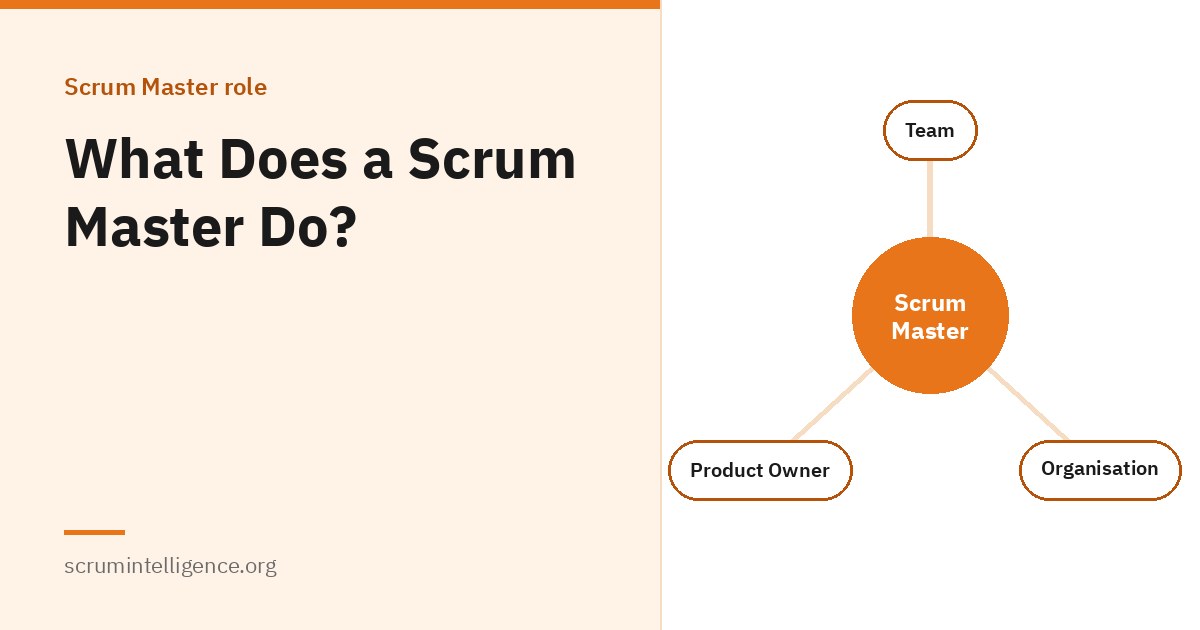
- The role serves the Scrum Team, the Product Owner and the wider organisation.
- Scrum Masters coach, teach and facilitate. They do not assign work or manage performance.
- Much of the job is about impediments: noticing them early and making sure they get resolved.
- The role changes as a team matures, moving from teaching Scrum basics to tackling organisational problems.
The short answer
According to the Scrum Guide, a Scrum Master is accountable for two things: establishing Scrum as the guide defines it, and the Scrum Team's effectiveness. They do this by helping everyone, inside the team and across the organisation, understand Scrum theory and practice. The guide describes Scrum Masters as leaders who serve the Scrum Team and the wider organisation.
Everything a Scrum Master does serves one of those two goals. If an activity does not help Scrum work better or make the team more effective, it probably is not the Scrum Master's job. For a wider introduction to the role and to Scrum itself, see our complete Scrum Master guide.
Where the role comes from
Scrum is defined in the Scrum Guide, written by Ken Schwaber and Jeff Sutherland. The current edition, published in November 2020, describes three accountabilities in a Scrum Team: the Scrum Master, the Product Owner and the Developers. The guide uses the word "accountabilities" rather than "roles" on purpose. It is less about job titles and more about who is answerable for what. In some organisations, one person holds the Scrum Master accountability as their full-time job; in others, it is part of someone's wider role.
Responsibilities to the Scrum Team
Coaching self-management and cross-functionality
A Scrum Team is self-managing, which means it decides internally who does what, when and how. For a team used to being told what to do, that is a big change. The Scrum Master helps the team grow into it. For example, when a Developer asks, "Who should pick up this item?", a Scrum Master is more likely to ask the team, "How do you want to decide that?" than to answer the question themselves.
Cross-functionality means the team has all the skills it needs to create value each Sprint. The Scrum Master helps the team spot skill gaps, share knowledge, and avoid situations where only one person can do a certain kind of work.
Keeping the focus on Done
The Scrum Master helps the team create high-value Increments that meet the Definition of Done. In practice, this often means helping the team finish work before starting new work, so that at the end of the Sprint there is something usable rather than several items that are almost finished.
Causing the removal of impediments
An impediment is anything that slows the team down or stops it from reaching the Sprint Goal. The Scrum Guide says the Scrum Master causes the removal of impediments, not that they remove every impediment themselves. The difference matters. A team that learns to solve its own problems becomes stronger; a team that waits for the Scrum Master to fix everything does not. We look at how to handle impediments in more detail below.
Making the events work
The Scrum Master makes sure all Scrum events take place and are positive, productive and kept within their timebox. That does not mean leading every event. The Daily Scrum belongs to the Developers, and a Scrum Master who runs it for them can easily turn it into a status meeting. The goal is for the team to get real value from each event. Our article on the five Scrum events explains the purpose and timebox of each one.
Responsibilities to the Product Owner
The Product Owner is accountable for maximising the value of the product and for managing the Product Backlog. The Scrum Master supports them by:
- Helping find techniques for defining the Product Goal and managing the Product Backlog. For example, introducing a simple way to order backlog items by value, or a clearer format for writing them.
- Helping the Scrum Team understand why clear and concise Product Backlog items matter. Vague items lead to confused planning and rework.
- Helping establish empirical product planning. In a complex environment, plans should be updated as the team learns, not fixed once and defended.
- Facilitating collaboration with stakeholders when it is requested or needed. For instance, running a workshop where stakeholders and the team explore a new feature together.
The Scrum Master supports the Product Owner but does not take over. Deciding what to build and ordering the Product Backlog remain the Product Owner's accountability.
Responsibilities to the organisation
Some of the biggest obstacles to a team's effectiveness sit outside the team. That is why the Scrum Guide gives the Scrum Master responsibilities to the whole organisation:
- Leading, training and coaching the organisation in its Scrum adoption. This might mean explaining to managers why the team should not be given extra work mid-Sprint.
- Planning and advising on Scrum implementations. For example, helping decide how several teams working on one product should coordinate.
- Helping employees and stakeholders understand and use an empirical approach to complex work. Many people are used to detailed plans made up front; the Scrum Master helps them see the value of inspecting and adapting.
- Removing barriers between stakeholders and Scrum Teams. For example, making sure the people who will use the product can actually take part in Sprint Reviews.
What a Scrum Master does in each Scrum event
Sprint Planning
Before Sprint Planning, the Scrum Master checks that the Product Backlog has been refined enough to plan with. During the event, they help the team keep to its three topics: why the Sprint is valuable, what can be Done, and how the work will get done. A good outcome is a clear Sprint Goal and a plan the Developers believe in.
Daily Scrum
The Scrum Master makes sure the Daily Scrum happens and stays within 15 minutes, but the Developers run it. A Scrum Master often attends to listen for impediments, and follows up afterwards rather than turning the event into a problem-solving session for everyone.
Sprint Review
The Scrum Master helps make the Sprint Review a working session, not a one-way demo. That can mean inviting the right stakeholders, encouraging honest feedback, and making sure the discussion leads to decisions about the Product Backlog.
Sprint Retrospective
The Scrum Master often facilitates the Retrospective and makes sure it leads to real improvements. Our guide on how to run a Sprint Retrospective covers structure, formats and follow-up.
Backlog refinement
Refinement is an ongoing activity rather than a Scrum event. The Scrum Master can help the Product Owner and Developers find a rhythm for it, so that items are clear enough to plan with when Sprint Planning comes around.
A typical week, as an example
No two Scrum Masters work the same way, and the Scrum Guide does not prescribe a schedule. As an illustration, a week for a Scrum Master supporting one team with two-week Sprints might include:
- Attending the Daily Scrum each morning and noting any impediments
- Meeting another team's Scrum Master to resolve a dependency between the two teams
- A one-to-one coaching conversation with a Developer who is new to Scrum
- Helping the Product Owner prepare a refinement session
- Talking with a manager about a request that would have disrupted the Sprint Goal
- Preparing the Retrospective, including a format suited to the team's current challenges
The different hats a Scrum Master wears
Depending on the situation, a Scrum Master moves between several ways of helping:
- Teacher: explaining Scrum, especially to new teams and stakeholders.
- Facilitator: helping groups have productive discussions and reach decisions.
- Coach: asking questions that help people find their own answers.
- Mentor: sharing experience with someone learning the role or the framework.
- Change agent: helping the organisation adjust its structures and habits so teams can work well.
A key skill is knowing which one a situation needs. Teaching when someone needs coaching, or coaching when someone simply needs information, both get in the way.
How a Scrum Master handles impediments
Impediments usually fall into three levels:
- Team level: problems the team can solve itself, such as an unclear process or a broken build.
- Cross-team level: dependencies on other teams, shared environments or conflicting priorities.
- Organisational level: policies, structures or habits outside the team's control, such as approval processes or people being split across too many projects.
A practical approach is:
- Make it visible. Record impediments where the team can see them.
- Check whether the team can solve it. If it can, coach the team to do so.
- If not, find who can. Raise it with the right person, and explain the effect on the team's work.
- Follow up. An impediment is only removed when the problem is actually gone.
- Look for patterns. Recurring impediments often point to a deeper organisational issue worth raising at a Retrospective or with leadership.
How the role changes as a team matures
With a new team, a Scrum Master spends a lot of time teaching Scrum and helping the events run well. As the team grows more confident, that work shrinks. The Scrum Master then spends more time on coaching individuals, supporting the Product Owner, and removing organisational impediments. A good Scrum Master is, in a sense, always working to make their day-to-day help less necessary.
The Scrum Master in remote and hybrid teams
Many Scrum Teams now work fully remotely or in a mix of office and home. The Scrum Master's accountabilities do not change, but some parts of the job need more deliberate effort:
- Making work visible. Without a physical board on a wall, a shared digital board becomes the team's main source of transparency. The Scrum Master helps keep it accurate and easy to read.
- Running events online. Online events need clearer structure, shorter segments and ways for quieter people to contribute, such as writing ideas before discussing them.
- Working across time zones. The Daily Scrum should suit the Developers. If the team is spread widely, the Scrum Master can help it find a time that works, or rethink how the team is set up.
- Noticing what is not said. Tension and disengagement are harder to spot on a video call. Regular one-to-one conversations help the Scrum Master stay aware of how people are really doing.
Working with managers and leadership
A Scrum Master works closely with managers, even though they do not manage the team themselves. Managers still matter in a Scrum organisation: they often control budgets, staffing, policies and priorities across teams. The Scrum Master helps them understand how Scrum works and what the team needs to succeed.
A common example is reporting. Some managers are used to regular status reports. Rather than producing extra reports, a Scrum Master can point them to the transparency Scrum already provides: the Product Backlog, the Sprint Goal, and the Sprint Review, where anyone with a stake in the product can see what has been done and discuss what comes next. When a manager's request would disrupt the Sprint Goal, the Scrum Master can explain the trade-off and involve the Product Owner, who decides on the Product Backlog.
Common challenges and how to handle them
The team sees the Scrum Master as an administrator
If the team expects the Scrum Master to book meetings and chase updates, the real value of the role gets lost. It helps to explain the accountability openly, and to hand simple admin back to the team where it makes sense.
The Product Owner is rarely available
Without an available Product Owner, the team struggles to understand priorities and to get quick answers. The Scrum Master can raise this as an impediment, help the Product Owner plan regular time with the team, and explore with the organisation whether the Product Owner has enough time for the role.
New work arrives in the middle of the Sprint
Urgent requests happen. The Scrum Master helps route them through the Product Owner, who can decide whether they go into the Product Backlog. If a change would make the Sprint Goal obsolete, the Product Owner has the authority to cancel the Sprint, although that should be rare.
Retrospectives feel pointless
This usually means actions are not being followed up, or people do not feel safe to speak honestly. Starting each Retrospective by reviewing the last one's actions, and changing the format from time to time, often brings the event back to life.
The team keeps carrying work over
Regularly unfinished work suggests the team is taking on too much, starting too many items at once, or working with items that are not clear enough. The Scrum Master can help the team look at the data together and decide on an experiment, such as limiting how many items are in progress.
Scrum Master vs Agile Coach
For a detailed comparison, see Agile Coach vs Scrum Master.
The Scrum Guide does not define an Agile Coach, so the title means different things in different organisations. In many companies, an Agile Coach works across several teams or at an organisational level, and may draw on a range of Agile approaches, not only Scrum. A Scrum Master is accountable for a Scrum Team's effectiveness and for Scrum being understood and used well. In practice, experienced Scrum Masters often do a lot of coaching, and many go on to become Agile Coaches. Scrum Leader Plus is designed for Scrum Masters taking that next step.
What a Scrum Master is not
- Not the team's manager. A Scrum Master does not assign tasks or appraise people's performance.
- Not the Product Owner. They do not decide what the product should do or how the backlog is ordered.
- Not a secretary. Booking rooms and taking notes can sometimes help, but they are not the core of the role.
- Not a project manager under another name. The differences are explained in Scrum Master vs project manager.
Build the skills with a certification
If you want to move into the role, Scrum Master Plus (Associate) includes 16 hours of training, an online exam on ExamVault by CertExpert with three attempts included, and a certificate and digital badge valid for two years. Our Scrum Master exam study plan can help you prepare.
Frequently asked questions
What is the main responsibility of a Scrum Master?
The Scrum Master is accountable for establishing Scrum as defined in the Scrum Guide and for the Scrum Team's effectiveness. Everything else, from coaching to removing impediments, serves those two goals.
Does a Scrum Master assign tasks to the team?
No. Scrum Teams are self-managing, so the Developers decide who does what and how. The Scrum Master helps them do that well.
Does the Scrum Master run the Daily Scrum?
No. The Daily Scrum is for the Developers. The Scrum Master makes sure it takes place and stays within 15 minutes, but the Developers choose its structure and run it.
Is the Scrum Master a full-time role?
The Scrum Guide does not say. It depends on the team's experience and the organisation. A new team usually needs more of a Scrum Master's time than a mature one, and some Scrum Masters support more than one team.
Who does the Scrum Master report to?
The Scrum Guide does not define reporting lines. Organisations set these up in different ways. What matters is that the Scrum Master can act in the team's interest and raise organisational impediments openly.
What skills does a Scrum Master need?
A deep understanding of Scrum, plus facilitation, coaching, conflict handling and clear communication with stakeholders. Our complete Scrum Master guide covers these in more detail.
How do I become a Scrum Master?
Learn the Scrum Guide, take structured training, get certified and practise with a real team. How to start a career as a Scrum Master sets out a step-by-step plan.