
Facts last checked: September 2026 against the published information of Scrum Alliance and Scrum.org. Fees and rules can change, so always confirm the current details before you enrol.
The Certified ScrumMaster (CSM) and the Professional Scrum Master I (PSM I) are the two best-known entry-level Scrum Master certifications. Both are based on Scrum, both are widely recognised by employers, and both are a sensible first step into the Scrum Master role. But they work in very different ways. This guide compares them side by side, using the published rules of each certification body, so you can choose the one that suits you.
Key takeaways
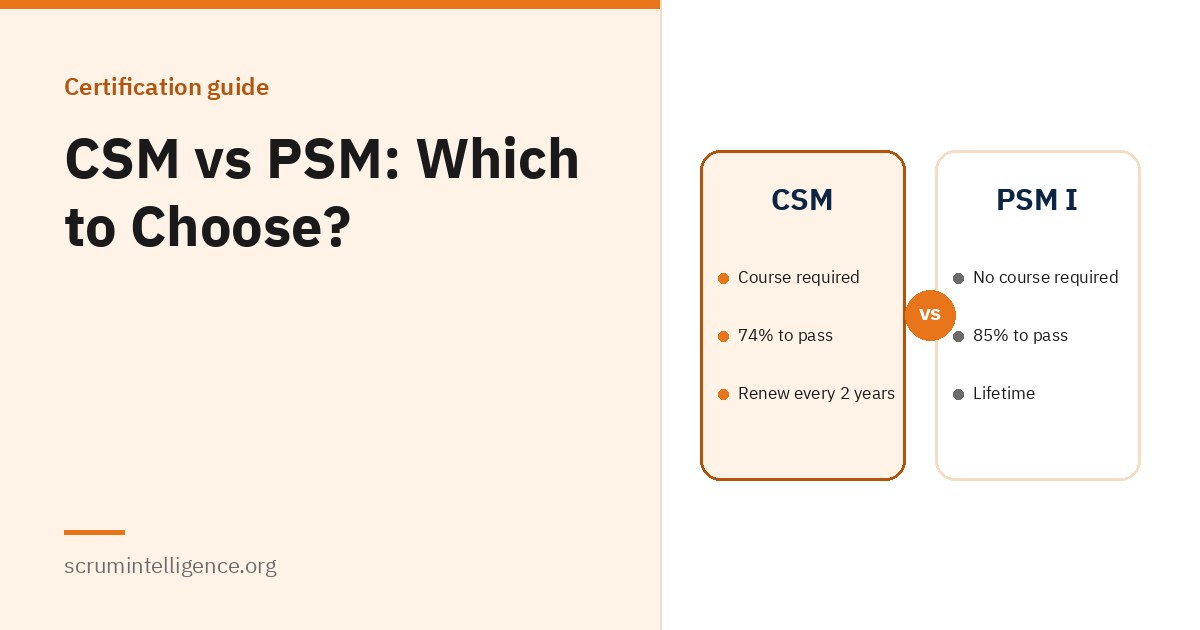
- The CSM requires a 16-hour course before you can take a 50-question test; the PSM I has no required course and is earned by passing an 80-question test.
- The CSM passing score is 74%; the PSM I passing score is 85%.
- The CSM course fee includes two test attempts; each PSM I attempt costs 200 USD.
- The CSM must be renewed every two years; the PSM I is a lifetime certification with no renewal.
- Neither is "better" for everyone. The right choice depends on how you like to learn, your budget and what employers in your market ask for.
CSM vs PSM I at a glance
| CSM | PSM I | |
|---|---|---|
| Issued by | Scrum Alliance | Scrum.org |
| Course required? | Yes, 16 hours with an approved trainer | No, although a course is recommended |
| Test | 50 multiple-choice questions, 60 minutes | 80 questions (multiple choice, multiple answer, true/false), 60 minutes |
| Passing score | 74% (37 of 50) | 85% |
| Attempts | Two included within 90 days of the welcome email; then 25 USD each | One attempt per 200 USD password; passwords do not expire until used |
| Cost | Course fee set by the trainer, usually including the test attempts | 200 USD per test attempt, plus any optional course |
| Renewal | Every two years, with Scrum Education Units and a renewal fee | None; lifetime certification |
| Language | Courses in many languages | Test in English |
The biggest difference: course-based vs test-based
The CSM is built around a mandatory course. You cannot take the CSM test until you have completed a 16-hour CSM course with a trainer approved by Scrum Alliance. The idea is that everyone who holds the certification has taken part in live training, with discussion and practical exercises.
The PSM I is built around the test. You can take it whether or not you have attended a course, and Scrum.org stresses that its certifications require proof of knowledge by passing the test rather than attendance. A course is recommended, and some candidates take one, but many prepare through self-study.
In practice, this means the CSM suits people who learn best in a structured, interactive class, while the PSM I suits confident self-learners.
Difficulty of the test
The PSM I test is generally considered the more demanding of the two. It has more questions in the same time (80 in 60 minutes, compared with 50 in 60 minutes), and a higher passing score (85% compared with 74%). The CSM test follows a course that prepares you directly for it, and includes three attempts.
Both tests are based on the Scrum Guide, so the same preparation helps for either. Our Scrum Master exam study plan covers how to prepare, including sample scenario questions.
Cost: what you actually pay
CSM
You pay for the course. The price is set by the trainer or training provider and varies widely by country, provider and format. It normally includes your two test attempts. After three attempts, or after 90 days, each further attempt costs 25 USD. Every two years, you also pay a renewal fee and need to earn Scrum Education Units.
PSM I
Each test attempt costs 200 USD. If you pass first time, that is the total cost, with no renewal fees afterwards. If you fail, you buy another attempt at the same price. If you choose to take a course as well, that is an additional cost, although Scrum.org courses include an attempt at the associated test.
Over several years, the PSM I usually costs less because there is no renewal. The CSM costs more up front because of the course, but that course is also where much of its value lies.
Renewal: two years vs lifetime
The CSM is valid for two years. To keep it active, you earn 20 Scrum Education Units and pay a renewal fee. Scrum Alliance sees this as proof that you keep learning.
The PSM I does not expire. Scrum.org states that its Professional Scrum certifications are yours for life, with no renewal costs or proof of future learning required.
Which employers ask for
Both certifications appear in Scrum Master job postings, and many postings accept either. Some employers or regions show a preference for one or the other. The best way to decide is to look at 15 to 20 job postings for roles you want, in your own city or country, and note which certifications they mention.
Remember that a certification helps you get noticed and shows your knowledge has been assessed, but employers also look closely at experience. Our Scrum Master salary guide shows the published salary ranges and what affects them.
Which should you choose?
Choose the CSM if you:
- Prefer learning in a live, interactive class with a trainer
- Want structured guidance and a clear route to the test
- Value the continuing-education structure that comes with renewal
- See it requested often in job postings in your market
Choose the PSM I if you:
- Are comfortable studying independently from the Scrum Guide
- Want to keep costs down and avoid renewal fees
- Want a certification that is earned purely by passing a demanding test
- See it requested often in job postings in your market
Some professionals eventually hold both. Scrum Alliance also accepts a PSM I or PSM II in place of the CSM as the prerequisite for its Advanced Certified ScrumMaster (A-CSM).
What comes next on each path
On the Scrum Alliance path, the CSM leads to the A-CSM and then the Certified Scrum Professional ScrumMaster (CSP-SM), both of which require Scrum Master work experience. On the Scrum.org path, PSM I is followed by more advanced PSM levels, each assessed by a more demanding test.
A third option: Scrum Master Plus
Scrum Intelligence offers its own online Scrum Master certification, Scrum Master Plus (Associate). It includes 16 hours of training and an online exam on ExamVault by CertExpert, with three attempts included. The certificate and digital badge, verifiable on LiveCertification, are valid for two years. It can be taken on its own or combined with a partner certification in the same enrolment. See the certification page for current learning paths and prices.
New to the role? Start with our complete Scrum Master guide, and read the full CSM guide for more detail on that certification.
Frequently asked questions
Which is harder, CSM or PSM I?
The PSM I test is generally considered harder: 80 questions in 60 minutes with an 85% passing score, compared with 50 questions in 60 minutes and 74% for the CSM.
Do I need a course for the PSM I?
No. A course is recommended but not required. You can buy a test attempt and take it when you are ready.
Do I need a course for the CSM?
Yes. The CSM test is only available after completing a 16-hour CSM course with an approved trainer.
How much does the PSM I cost?
200 USD per test attempt. Each password is valid for one attempt and does not expire until used.
Does the PSM I expire?
No. Scrum.org's Professional Scrum certifications are lifetime certifications with no renewal.
Does the CSM expire?
The CSM is valid for two years and is renewed with 20 Scrum Education Units and a renewal fee.
Which do employers prefer?
It varies by employer and region, and many job postings accept either. Checking job postings in your own market is the most reliable guide.
Can I hold both?
Yes. They are issued by different organisations, and some professionals hold both.